
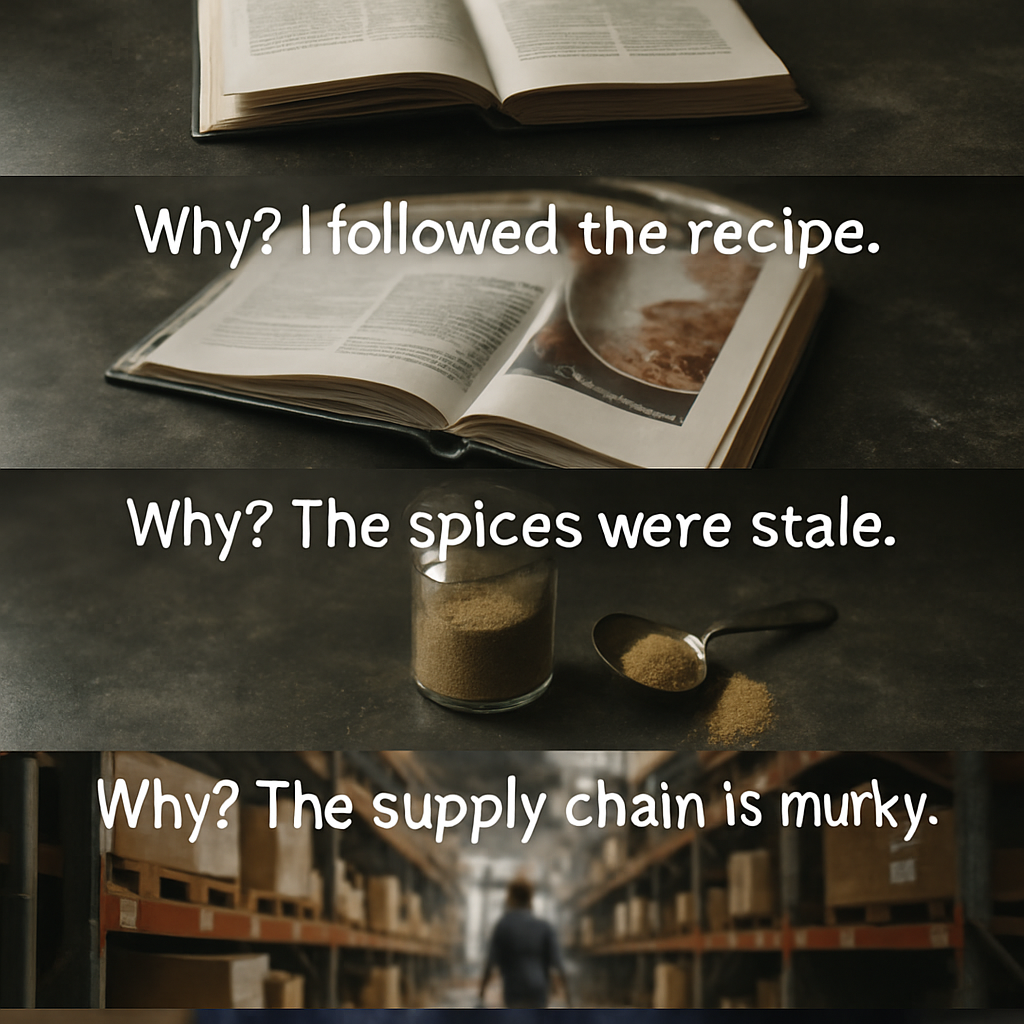
TL;DR: You cooked the dish right and it still came out muted, so you blamed yourself. Ask “why” five times and the trail leads past your recipe to the real culprit: an anonymous, unhurried supply chain where nobody is accountable to you for freshness. The fix isn’t a better recipe. It’s knowing where your spice came from and when it was ground. That’s the whole reason Trevean exists.
There’s an exercise I keep coming back to, in business and in the kitchen. Whenever something’s broken, and the obvious explanation feels too easy, I run the Five Whys, a root-cause tool invented on the Toyota factory floor that I’ll come back to at the end. You ask “why” five times. Each answer becomes the next question. By the fifth, you may finally be looking at the cause instead of the symptom.
Let me run it on the saddest shelf in your house. Your spice rack.
Here’s the moment I want you to picture, because it’s happened to all of us. You cooked the dish right. You followed the recipe, you didn’t rush it, and you did everything the way you were supposed to. And it came out muted, like listening to your favorite song through a wall. Fine, technically. But not what you were hoping for. So you did what most of us do, which is quietly assume you’d lost a step somewhere.
You hadn’t. Let’s find out where the flavor actually went.
Why did it taste flat? (#1)
Because the spice you reached for barely smelled of anything. You shook it over the pan and got dust, not warmth. No lift, no perfume, no bloom of aroma when it hit the heat. None of that rush of aroma that should come off a hot pan and make you lean in.
Why did the spice have no smell? (#2)
Because the smell is the flavor. This isn’t a nice metaphor. It’s how tasting actually works. Sensory scientists have argued for decades over the exact fraction, and the range they land on is wide. Charles Spence, the Oxford experimental psychologist who runs the university’s Crossmodal Research Laboratory, notes that it’s “frequently asserted that somewhere between 75 and 95% of what we commonly think of as taste actually comes from the sense of smell.” He is careful about the exact percentage, but nobody in the field disputes that smell does most of the heavy lifting that your tongue gets credit for.
So a spice that’s lost its scent has lost the plot. And that jar had lost its scent because it was old. Not rotten, because spices don’t rot. As Healthline’s medically reviewed guide puts it, spices past their prime “aren’t dangerous to consume, but they will lose their aroma and flavor potency over time.” The bright notes disappear. What remains is dull and one-dimensional. The jar did not fail overnight. It faded.
Why was it so old? (#3)
Because we do not treat spices like other fresh ingredients. Milk has a date. Meat changes color. A lemon shrivels on the counter and lets you know its best days are behind it. A jar of cumin can sit quietly in the cabinet for three years and look exactly the same.
Ground spices fade fast. The Spice House says they “hold their best flavor for up to one year,” but that “you will notice their flavor beginning to change after six months.” That jar of yours might have been open for two or three years, sitting on a warm rack above the stove, going a little quieter every week.
It’s a real and specific kind of decline, and once you’ve smelled it, you can’t unsmell it. One storage guide from the Fond kitchen team describes keeping spices on a magnetic strip above the stove and finding that “six months in, my smoked paprika smelled like cardboard, and my cumin had the flavor intensity of sawdust.” And here’s the part that stings: your jar was probably already old the day you carried it home.
Why was it old before you even bought it? (#4)
Because of the journey it took to reach you. A conventional spice doesn’t go from farm to shelf. As Sana Javeri Kadri, founder of the direct-trade spice company Diaspora Co., describes it, the conventional trade runs “farmer to trader, trader to bigger city trader, trader to big auction house, auction house to exporter,” as many as ten or twenty pairs of hands. At every step, it waits in a warehouse while somebody holds out for a better price. “Somebody held it for one year because they wanted a better price, and somebody else held it for one year because they wanted a better price,” Kadri says. “There’s no urgency to get it to the customer.” Her blunt estimate: “Conventional spices can go to the consumer and be up to seven years old sometimes.”
Not because someone is trying to ruin your dinner. Because the system was built to trade a commodity. A bag can wait for a buyer. A trader can wait for a better price. Inventory can sit until the next handoff makes economic sense. The spice keeps getting older while everyone is doing exactly what the system allows them to do.
Which led me to the fifth why.
Why does nobody in that chain care whether it’s fresh? (#5)
Because nobody in that chain is accountable to you. By the time most spices reach the shelf, the details that would help you judge freshness are gone. Nobody wrote down which farm it came from, what season it was picked, or the day it was ground. And once it’s been blended with product from dozens of farms across different continents and harvests, that story is gone for good. A 2021 EU study of 1,885 herb and spice samples found nearly one in five was adulterated or padded with something undeclared. Oregano was the worst, with 48% of samples cut with cheaper leaves.
That’s what happens in the dark. You can’t ask a jar a question, and a supply chain that can’t trace its own product back to a farm was never built to tell you the truth about it. It was built to move product cheaply. Freshness was never the point.
One anonymous, unhurried supply chain. That’s the root. Not your cooking, not your recipe, not you.
Why ask why?
We could keep going. Why is the chain that long? Why does blending hide the age? You can always ladder down another rung. But the number of questions was never the point.
Symptoms are seductive because they are close enough to touch. Does dinner taste flat? Add more cumin. Still flat? Buy another jar. Still happening? Find a different recipe. You can spend a long time solving the problem directly in front of you without ever asking whether you are solving the right problem. Buying a fresh jar from the same anonymous system may make dinner taste better tonight. But you have only restarted the clock.
The fifth why changes the solution.
That’s the whole reason Trevean exists. Every jar we make carries its own story, and you don’t have to take our word for it. You tap the jar with your phone and read it yourself. The farm it came from. The day it was harvested. The day it was ground. No anonymous middle, no mystery warehouse years, just a straight line from a farmer we actually know to the jar in your hand.
We built it that way because we got tired of the flat answer everyone accepts, that spices just taste like that. They don’t. A spice you can trace is a spice somebody stayed accountable for, which means it reaches you while it still has its warmth, its brightness, its aroma. Open a jar of Persian Sunrise or North African Night Market, and you’ll smell the difference before you’ve cooked a single thing. That first hit of aroma when the lid comes off is the whole point. It’s what your old jar used to smell like, once, before the chain wore it out.
One more thing, since I promised. The Five Whys was invented by Sakichi Toyoda, the founder of the company that became Toyota, and his whole idea was to never accept the first easy answer. As his engineer Taiichi Ohno put it, “by repeating why five times, the nature of the problem as well as its solution becomes clear.” I think that’s a good way to run a company, and it turns out it’s a good way to run a kitchen too.
So the next time dinner tastes like it’s coming through a wall, don’t blame yourself. Ask why. Then tap the jar.
FAQ
What is the Five Whys? It’s a root-cause exercise from the Toyota production system. You ask “why” repeatedly, with five as the rule of thumb, until each answer stops describing a symptom and starts describing the underlying cause. Fixing that cause is what actually stops the problem from coming back.
Do old spices go bad or become unsafe? No. Spices don’t spoil in a way that’s dangerous. They lose aroma and potency. As Healthline’s guide notes, they “aren’t dangerous to consume” past their prime; they just get progressively flatter and more one-dimensional.
How long do ground spices actually last? The Spice House puts the best flavor at up to a year, with a noticeable change starting around six months. The catch is that the clock often started long before you opened the jar, because of how long the spice waited in the supply chain.
Isn’t the “seven-year-old spice” claim exaggerated? It’s one founder’s industry estimate, not a lab measurement, and she sells the fresh alternative, so treat the exact number with a grain of salt. But the underlying pattern, a long chain with many intermediaries and lots of price-driven waiting, is well documented across the trade.
What’s the one thing I should do this week? Open your most-used jar and smell it honestly. If it opens with a whisper instead of filling the room, that’s your answer. Next time, buy something you can trace back to a farm and a grind date, not a jar with no story to tell.
Related: Your spice has a passport now and The cumin test both dig into why provenance is the product, not a nice-to-have.
Dan
Leave a Reply