
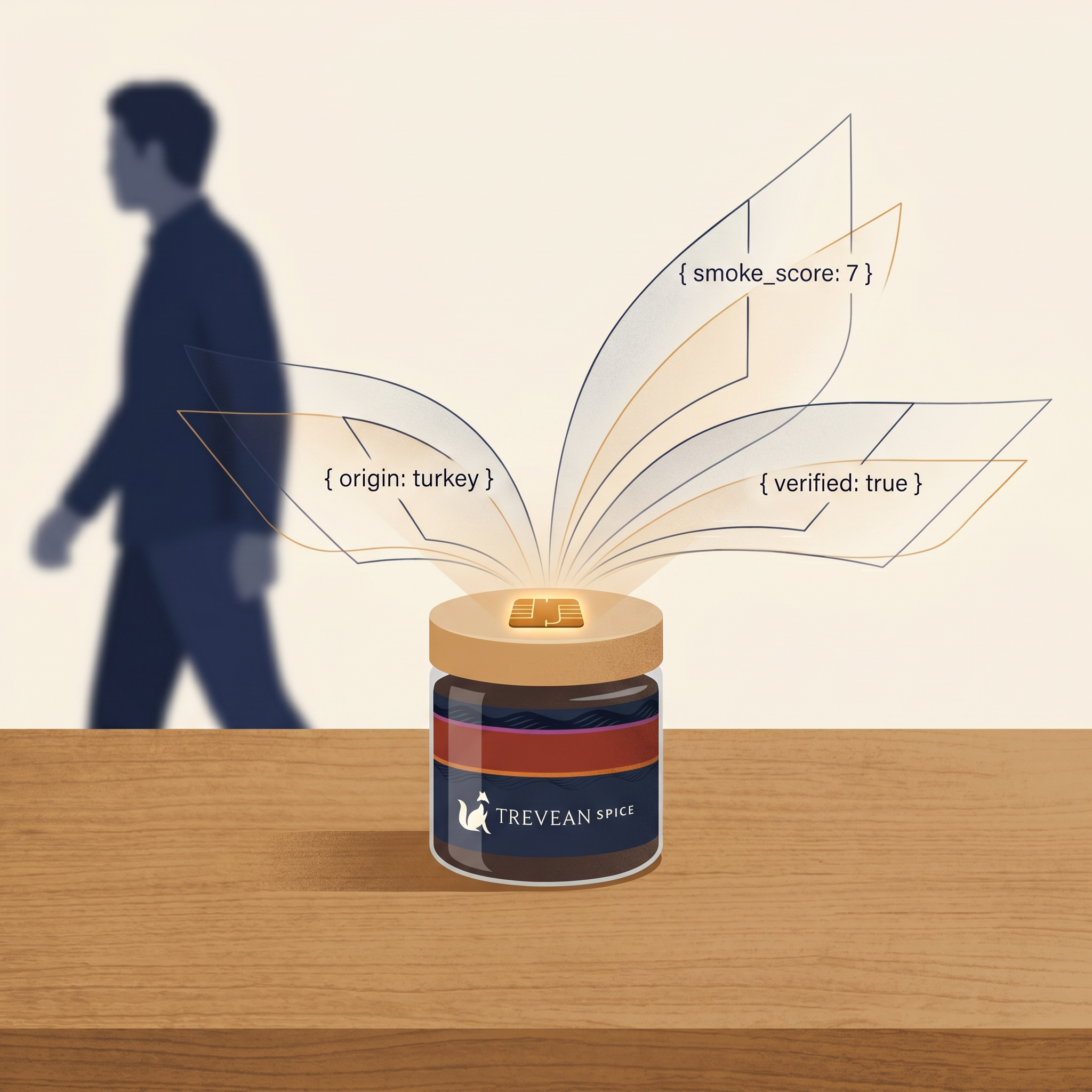
TL;DR At the Open Source Summit, Anurag Sinha of Google walked the audience through the Universal Commerce Protocol (UCP), an open standard for letting AI agents transact directly with merchants. The talk made one thing concrete for product managers: a lot of what we design (funnels, hero images, CTA copy) is invisible to the buyer when the buyer is an agent. The PRD has to change. Three lines I’m rewriting this week: User Journey → Intent Surface, Trust Signals → Trust Receipts, Conversion Funnel → Capability Manifest. The opportunity for small brands is real, but only if your product is legible to the agentic web.
I was sitting in a back row at the Open Source Summit this week, half-listening, half-scrolling through a Trevean Spice support thread, when a sentence from the stage made me put my phone down.
“The commerce web is shifting from click-to-buy to intent-to-execute.”
The speaker was Anurag Sinha, Senior Staff Software Engineer & Manager at Google, where he leads engineering for Commerce AI Native Integrations and is building the Universal Commerce Protocol (ucp.dev), an open standard meant to eliminate the fragmentation between AI surfaces (Claude, ChatGPT, agent-native shopping environments) and the actual retail backends that fulfill orders. He walked through a capability-based system where agents don’t navigate your store; they negotiate with it. They don’t click your “Add to Cart” button; they call a function. They don’t see your hero image; they read a capability manifest.
And the part that stuck with me was the implication underneath all the architecture: a huge chunk of what product managers spend their week designing the funnel, the copy, the gradient on the CTA is becoming invisible to the buyer.
The buyer isn’t actively searching; it’s the buyer’s agent who is.
This isn’t the first time I’ve come at this. Back in February, I wrote about what happens when AI shops on your customer’s behalf. The algorithm helps you get noticed, but it is the human element that maintains their interest. A few weeks later, I followed up /why-excitement-doesnt-equal-habit/) The missing link between AI discovery and actual loyalty. Last summer, I went further out, calling it the coming distribution wars: AI platforms quietly becoming the distribution layer every consumer brand has to fight for. UCP is the part of that story I didn’t yet have a name for. It’s the plumbing that decides who shows up when the agent goes looking.
That’s not an issue for 2030. It’s a matter of updating my PRD template. And the longer I sat with it, the more I realized this isn’t a story about a new protocol; it’s a story about which PRD lines we’ve been getting away with leaving blank, and which ones we can’t anymore.
Here are the three I’m rewriting.
1. Replace “User Journey” with “Intent Surface.”
The old PRD line was something like: “User lands on the spice page, scans the description, watches the origin video, adds to cart.” That sentence assumed eyes. It assumed scrolling. It assumed the slow seduction of a well-designed page.
The new line the one UCP and every adjacent protocol I’ve looked at since seem to push toward is: “Agent receives an intent (e.g., ‘find a smoky paprika under $20 from a small producer’), queries our capability surface, and returns a recommendation.”
That’s not a journey. That’s a query.
For PMs, the practical shift is this: every product attribute that used to live in marketing copy now needs to live in a structured, machine-readable form somewhere an agent can actually consume it. “Smoky,” “small producer,” “single-origin,” “harvested in the last six months,” those aren’t poetic anymore. They’re query parameters.
Which means a PRD for a new product page in 2026 needs a section that didn’t exist in 2024: what is the canonical, structured representation of this product for non-human consumers? If you can’t answer that, you don’t have a product page. You have a billboard nobody’s driving past.
2. Replace “Trust Signals” with “Trust Receipts.”
This one hit me hardest because it connects directly to what I wrote about transparency a few weeks back (Transparency Isn’t a Feature, It’s the Floor). When the customer is a human, you earn trust with vibes: testimonials, photography, a founder video, the badge that says “as seen in.” You can do the work of trust cosmetically.
When the customer is an agent acting on someone’s behalf, vibes don’t survive the API call. The agent doesn’t care that your founder video is moving. The agent cares whether your sourcing claim is verifiable because the agent’s principal (the human) is going to ask “why this one?” and “is it actually small-batch?”, and the agent has to answer with something more durable than a vibe. I argued this more bluntly back in March: AI can now smell a fake. Agents notice the gap between what you say and what you can prove. They route around it.
This is where the NFC work we’ve been doing at Trevean stops looking like a marketing flourish and starts looking like infrastructure. A tap that resolves to a signed provenance record isn’t just a customer experience; it’s a trust receipt an agent can carry into a recommendation. “This product’s claims are attested by X, signed by Y, last verified on date Z.”
The PRD line I used to write was: “Add testimonial carousel to PDP.” The PRD line I’m writing now is: “Every product claim must resolve to a verifiable, machine-readable attestation.” Same goal, earn trust, completely different implementation.
If your product makes claims you can’t structurally back, agentic commerce will quietly stop surfacing you. Not because anyone blocked you. Because the agents on the other side will route around claims they can’t verify, just as water routes around a rock.
3. Replace “Conversion Funnel” with “Capability Manifest.”
The funnel is a human metaphor. It assumes a person moves through stages of awareness, consideration, intent, purchase, and that your job as a PM is to reduce friction at each stage.
Agents don’t have stages. Agents have capabilities they can call. If your store exposes “search products,” “filter by attribute,” “check stock,” “reserve inventory,” “complete checkout” as clean, well-documented, predictable functions, you are legible to the agentic web. If you don’t know if your checkout is a six-step modal that requires a captcha and assumes a human reading order, you are functionally absent.
This is the part that opens a real door for small brands, and it’s the angle that made me want to write this post in the first place and the one I keep returning to in the distribution wars piece. UCP and protocols like it lower the barrier in a specific way: a Trevean Spice doesn’t need to outspend a McCormick on shelf-equivalent SEO or paid placement. We need to expose a clean capability surface and back our claims with verifiable provenance. That’s a fight a four-person company can win. That’s a fight a four-person company can only win when the playing field shifts from “who has the bigger ad budget” to “who is most legible to the agent.”
The PRD line I’m adding: “Every customer-facing capability must have a corresponding machine-callable endpoint with a documented contract.” If marketing wants a new feature, engineering builds the human and agent surfaces. Same scope. Same definition of done.
What does this change mean for being a PM?
I’ve been writing a lot lately about Build-to-Learn / Build-to-Earn, the verb the Product Onion was missing. UCP gave me a sharper frame for what we should be building to learn about right now.
If you’re a PM in 2026, three things are quietly true:
The first is that your product’s surface area just doubled. Whatever you build for humans, you now also build for agents. Treat it as a first-class user, with its own user research (read: read the protocol specs and the agent SDKs your buyers’ agents are actually using), its own acceptance criteria, and its own definition of “a good experience.”
The second is that the units of your product have changed. You used to ship screens. You’re now shipping capabilities and attestations. The screen is one rendering of those underlying things. A capability without a screen still has value. A screen without a clean capability behind it is, in agentic terms, a dead end.
The third, and this is the one I keep coming back to, is that the work of trust got more expensive and more valuable at the same time. You can no longer fake it when it comes to design. You actually have to wire it in. But once you do, that trust travels with your product through every agent in the ecosystem. It compounds in a way that a homepage redesign never did.
What I’m doing about it on Monday
I’m not telling the team to chase UCP specifically. Standards in this space are still moving, and any single one of them might lose. What I am doing:
I’m adding a “machine-readable representation” section to our PRD template. Every new product or product change has to answer the question: what would an agent see when it asks about this?
I’m asking the engineering team to inventory which of our customer-facing capabilities already have clean API counterparts and which don’t. Not to expose them publicly tomorrow, just to know where the gaps are.
And I’m treating the NFC + provenance work not as a marketing feature anymore, but as the trust receipt layer for every claim we make. Because when an agent eventually asks “Is this paprika actually single-origin from where Trevean says it is?”, I want the answer to be a signature, not a sentence.
The keynote ended with Anurag saying that UCP, or something like it, would become “the connective tissue for the next generation of digital transactions.” That’s the sort of line that’s easy to dismiss as conference talk. But the part that wasn’t dismissible was the implication for PMs in the room: the buyer you’ve been designing for is being joined, and in some cases replaced, by a buyer that doesn’t have eyes, doesn’t have patience, and doesn’t grade on aesthetics.
The PRD I write this week is the first one where I’m taking that seriously.
Related reading from PMJ
If this post resonated, the through-line continues across a few earlier pieces:
- The Coming Distribution Wars why AI platforms quietly become the distribution layer every consumer brand has to fight for.
- When AI Shops for Your Customer the algorithm gets you discovered; the human touch keeps them.
- Why Excitement Doesn’t Equal Habit the missing link between AI discovery and customer loyalty.
- AI Can Now Smell a Fake why unverifiable claims will quietly stop surfacing in agent-mediated commerce.
- Transparency Isn’t a Feature, It’s the Floor the trust argument this post extends.
- Build-to-Learn / Build-to-Earn the verb the Product Onion was missing, and the lens I’m using to decide what to build first for agents.
- How Generative AI Is Reshaping SEO the SEO → AEO transition that the FAQ below touches on.
FAQ
What is the Universal Commerce Protocol (UCP)? UCP (ucp.dev) is an open standard, led by Anurag Sinha and team at Google, for letting AI agents transact directly with merchants. Instead of agents scraping websites or learning bespoke checkout flows, merchants expose a capability surface (search, filter, reserve, purchase) that any agent can call in a standard way.
Is UCP the only protocol in this space? No. Several standards and pre-standards are emerging across the agentic commerce stack (MCP for tool-calling at the agent layer, ACP and adjacent commerce protocols at the merchant layer, plus model-specific shopping APIs). UCP is one of the more developed open efforts, but as a PM, you should be designing for the pattern, clean, machine-callable capabilities, and verifiable claims, not for any one specific protocol that might lose out.
What does this mean for SEO? SEO doesn’t disappear, but it gets a sibling: AEO answer engine and agent engine optimization. Structured data, verifiable claims, and machine-readable capability surfaces are to the agentic web what backlinks and meta descriptions were to the search web. I covered the SEO half of this shift in How Generative AI Is Reshaping SEO; this post is the agent half.
How does a small brand actually compete in agentic commerce? By being the most legible option in its niche. Small brands typically lose at scale (ad spend, shelf space) and win at specificity (single-origin, small-batch, named producer). Agentic commerce rewards specificity because agents resolve queries like “smoky paprika under $20 from a small producer” exactly. If your product can answer that query in a structured, verifiable form, you don’t need a bigger budget; you need a cleaner capability surface and a backed-up claim. See also The Coming Distribution Wars.
What’s the single thing I should do this week? Add one section to your PRD template: “What would an agent see when it queries this product or feature?” Answering that one question well will surface the other gaps.
About the speaker
Anurag Sinha is a Senior Staff Software Engineer and Manager at Google, leading engineering for Commerce AI Native Integrations and the Universal Commerce Protocol (ucp.dev). Before his current role, he led teams at Google focused on AI-powered shopping experiences across Search and Ads. Prior to Google, he spent nearly ten years at PayPal as a Senior Engineering Manager and Architect on core checkout and payment platforms, where his work powered millions of daily transactions across PayPal, Venmo, and Braintree.
If you’re rewriting your own PRD template for this shift, I’d love to compare notes on what you added and what you cut. Reply and tell me.