
TL;DR Greg Isenberg posted seventeen takeaways from a recent SF trip and the consumer-AI rooms he sat in. Four of them: consumer AI is underbuilt, building for agents is the new SEO, usage intelligence is the new alpha, and Mission Street still doesn’t use any AI. I describe the playbook I’m running at Trevean Spice. The angle worth borrowing isn’t “go build another consumer app.” It’s that the unglamorous physical things in your cabinet are the most underbuilt category in consumer right now, and the intelligence layer is what separates a premium brand from a category creator.
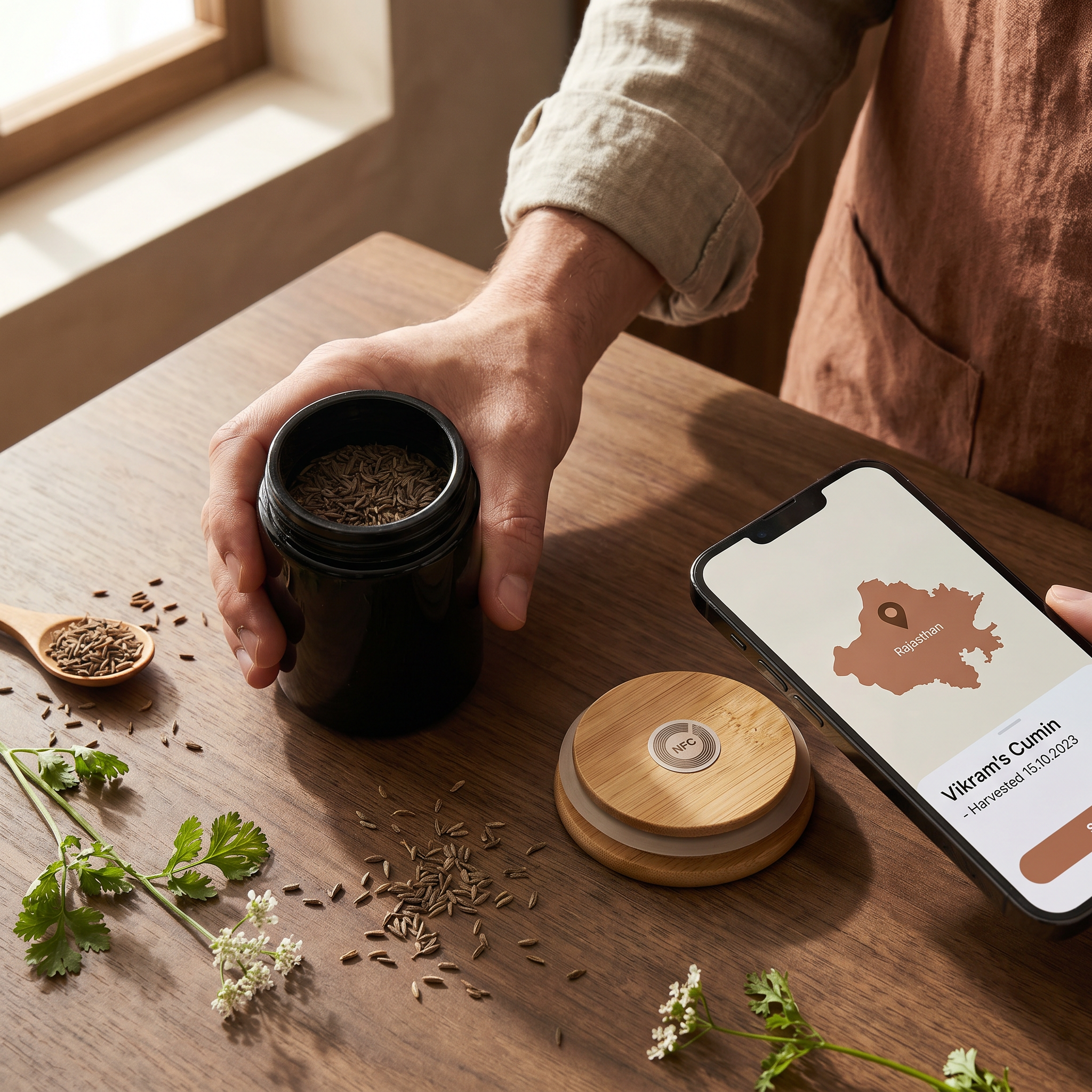
The chip is the size of a quarter. It lives on the bottom of a bamboo lid, under a thin disc of cork. You don’t see it. You don’t know it’s there until you tap your phone to the jar and a farm in Rajasthan loads on your screen: Vikram’s name, his coordinates, the harvest window that put this particular spoonful of cumin in your hand.
I was holding one of those lids, a sample, off-line, before our Pulp+Wire creative handoff when Greg Isenberg’s “seventeen takeaways from SF” landed in my feed. Greg is the CEO and co-founder of Late Checkout, a holding company that builds community-led internet businesses, and he writes one of the more honest field reports on what’s actually being funded versus what’s actually being built. I read it twice. Once over coffee, like everyone else. Once at my desk, with the lid still in my left hand.
By the second read, I’d stopped reading it as a list of SF observations and started reading it as a map.
The thing I couldn’t unsee
Most of Greg’s seventeen observations are about software. SaaS rebuilds, MCP endpoints, forward-deployed engineers, voice agents, the gap between SoMa and the Mission. Read fast; it’s a state of the union for AI-native companies.
Read slowly, and four of his points stop being about software.
They’re about whether anyone is building intelligence into the parts of life people actually touch: the cabinet, the jar, the cooking moment. Greg basically dismisses this and moves on. I run a spice company. I can’t move on. So here are the four that hit different from where I’m sitting, and what I’m actually doing about each one.
1. Consumer AI is massively underbuilt, and the physical consumer is even more underbuilt
Greg’s point #3, paraphrased: every billboard in SF is B2B inference infra or vertical agents. The whole city is optimized for enterprise. Meanwhile, a single consumer app (Cal AI) did $50M ARR in 18 months. The consumer is wide open.
I’d take that idea a step further: not only is consumer software underdeveloped, but so is consumer anything you can hold. The intelligence layer has scarcely touched physical goods beyond sneakers and cars. Consider the typical pantry: a jar of cumin today holds about the same amount of information as a jar from 1995, maybe the origin country printed on it, a best-by date, and a barcode linking to a SKU, but little more.
The opportunity isn’t “AI for cooking.” The opportunity is to make the jar itself a node. The Trevean bet and why we call ourselves the Spice Intelligence Platform is that the physical product can carry its own provenance, its own freshness signal, its own connection back to the grower, without the user having to do anything except tap. The intelligence isn’t in an app you have to remember to open. It’s in the lid.
That’s a very different thesis than “we sell premium spices with a story.” It’s: the product is the data, and the brand is the explanation of what the data means.
2. Building for agents is the new SEO, even if the product is a spice jar
Greg’s point #4: companies exposing themselves as MCP endpoints are getting pulled into deals they never pitched for. The ones that aren’t are becoming invisible to agents. If agents can’t find you, you don’t exist.
The reflex is to assume this only applies to software. It doesn’t. The agent economy will touch physical goods, recipe agents, meal-planning agents, grocery agents, and eventually personal cooking agents. When one of those goes looking for “cumin from a named, traceable source in Rajasthan,” what comes back? Today, almost nothing. Even brands with sourcing stories live in PDFs and About pages content optimized for humans, not machines. (I’ve written separately about what changes when the buyer is an agent and not a person, and how the PRD has to change with it.)
How we’re operationalizing the agent layer: every blend has a structured record named growers (Vikram in Rajasthan, Rushi for coriander, Marco outside Siena), GPS coordinates, harvest window, processing notes sitting in the data model, not buried in a press kit. Every jar’s NFC chip (the ST25TV02KC from STMicro, UID-keyed) is its own addressable unit. And the NFC tap lands on a page that’s also crawlable: a human reads “Vikram, Rajasthan, March 2026 harvest”; an agent reads structured data it can use.
The strategic point isn’t “add structured data so we rank better.” It’s that physical brands that don’t expose themselves as queryable will be invisible to the cooking layer about to get built on top of every kitchen. Greg’s “MCP is the new SEO” applies to your spice jar, your olive oil, your salt. We just have to build for it first, before the agents arrive.
3. Usage intelligence is the new alpha at the jar level
Greg’s point #2: frontier model companies can see API calls and token counts. They can’t see the actual workflows. If you’re deep in a niche, that understanding of the workflow is incredibly valuable.
This is the one that quietly excited me the most. Substitute “spice jar” for “API call” and the argument gets sharper, not weaker.
McCormick the conglomerate I get compared to most can see which SKU sold at which Kroger on which week. They cannot see which jar of cumin was tapped on a Tuesday night in Brooklyn by a 34-year-old who’d just pulled up a recipe for chana masala, tapped twice (once to read about Vikram, once to confirm the harvest), and then reordered eight days later. That sequence jar to tap to context to repurchase is the alpha. It’s the data they can’t generate in a structured way because their packaging is dumb plastic and their distribution is wholesale.
UID-keyed NFC isn’t a vanity feature. It’s the workflow lens. Every tap is a data point with a unit-level identity behind it. Over time, that becomes:
- A real freshness signal – when did this specific jar enter circulation vs. when was it last engaged with?
- A real provenance signal – which farm’s cumin produced the strongest repeat behavior?
- A real cultural signal – which recipe contexts pull which blends.
I’m not chasing this data to monetize it. I’m chasing it because it’s how a small, founder-led brand outruns a $7B incumbent: by knowing things about the customer’s actual cooking life that the incumbent’s distribution model literally prevents them from seeing.
That’s also why we deliberately chose to keep the MVP simple. Adhesive NFC sticker on the bamboo lid, QR fallback for non-NFC phones, Squarespace origin pages while Shopify Plus comes online. The point of the MVP isn’t the chip technology. It’s the data model behind it. Get the model right, and the chip can get cheaper, smaller, more embedded, and more elegant as volume scales.
4. Mission Street doesn’t use AI, and the spice cabinet is Mission Street
This is the takeaway Greg almost throws away, point #15, in the middle of the list. He walks around the Mission and notices the taquerias, the barbershops, the laundromats. None of them use any AI at all. The supposed AI capital of the world, and the storefronts at street level are untouched.
Your spice cabinet is the same thing. The most invisible categories in the home are the most untouched by software. Olive oil. Salt. Tea. Spices. Shelves full of products with effectively zero intelligence added in two decades, sitting in homes where the residents carry a supercomputer in their pocket.
The Mission Street observation is a roadmap disguised as a complaint. The most overlooked opportunities don’t look like typical AI applications; they look like spice jars.
This is also what the 5% rule is for: designing every detail of the package for the small slice of customers who’ll notice everything, because they become the evangelists who pull the other 95% in. You don’t try to convert the whole spice aisle on day one. You build a product the 5% can fall in love with, and let them do the explaining.
Greg’s observation about the Mission is, I think, a permission slip. You don’t have to be inside the SF bubble to build the thing the SF bubble is missing. You probably have to be outside it.
What I’m doing this week
Concrete. First-person. Not “you should.”
- Closing the Pulp+Wire creative handoff so the labels ship with structured provenance in the visual hierarchy: Vikram’s name, the Rajasthan coordinates, the harvest window as part of the design, not as small print.
- Specifying the NFC landing page as crawlable structured data with Phil at Microgroove, so when the next wave of recipe and grocery agents shows up looking for traceable spices, they can read us.
- Writing Rajasthan Gold’s spec in the same format as the first five blends, so the data model holds across the line. Same for the Tuscan blend after Marco’s harvest details come back from Siena.
- Resisting the urge to chase voice agents or AR for launch. Greg mentioned voice. It’ll come. Not in the MVP. The MVP is: jar, lid, chip, page, story. The intelligence layer compounds from there.
The shortcut isn’t to build in SF or to ship faster than the AI-native consumer apps. It’s to be the first brand in a Mission Street category to ship with the intelligence layer baked in and to do it before the agents arrive looking for someone to point to.
The jar’s already in my hand. The chip is already on the lid. The agents aren’t here yet. That’s the window.
FAQ
What is a “spice intelligence platform”? Trevean’s thesis is that the product itself not an app, not a website should carry its own provenance, freshness, and origin story, and be readable by both the human holding it and the software increasingly making cooking decisions on the human’s behalf. The intelligence sits in the jar via NFC, with structured data behind it.
Why NFC and not just a QR code? Both, actually. NFC is the primary tap experience; QR is the fallback for phones that don’t support NFC. NFC matters because each chip carries a unique UID, allowing us to track individual units, not just SKUs. A QR code on a printed label is a single identity shared across thousands of jars. An NFC chip is one identity per jar. That’s the workflow lens.
Isn’t this just expensive spices with a good story? The story is the surface. The infrastructure underneath per-unit identity, structured provenance, named farmer relationships, and agent-readable origin pages is the actual product. Without that infrastructure, the story is marketing. With it, the story is verifiable, and the brand becomes a data company that happens to sell spices.
How is this different from a McCormick or a Burlap & Barrel? McCormick is a distribution-led conglomerate. Their packaging is dumb plastic by economic necessity at their scale, and they cannot generate per-unit usage data because their model doesn’t come anywhere close to the cooking moment. Burlap & Barrel and Diaspora Co. have wonderful sourcing stories (I learn from both of them), but those stories live in the PDF-and-About-page layer. The Trevean bet is that the next premium spice brand is one whose data model is built for the agent economy from day one.
What’s the skeptic’s read on Isenberg’s “agents are the new SEO” point? Fair pushback: agent-discoverability matters more for software than for physical goods that still have to be shipped, smelled, and tasted. True for the next 12 months. Less true on a 3-year horizon. The downside of preparing early is small (structured data is cheap to add). The downside of being late is being invisible to a cooking layer that’s already being prototyped.
What’s the one thing a PM should take from Greg’s seventeen this week? Pick the most “Mission Street” category in your industry, the part that’s been untouched by software for a decade, and ask whether your product could be the first to carry an intelligence layer into it. The opportunity is rarely where the billboards are pointing.
About the source
Greg Isenberg is CEO and co-founder of Late Checkout, a holding company that builds and acquires community-led internet businesses. He previously founded Islands (acquired by WeWork, where he became Head of Product Strategy and 5by (acquired by StumbleUpon), advises Reddit, and writes “Greg’s Letter” and hosts the Where it Happens podcast. His seventeen-takeaway post, paraphrased throughout this piece, came out of a recent trip to SF.