
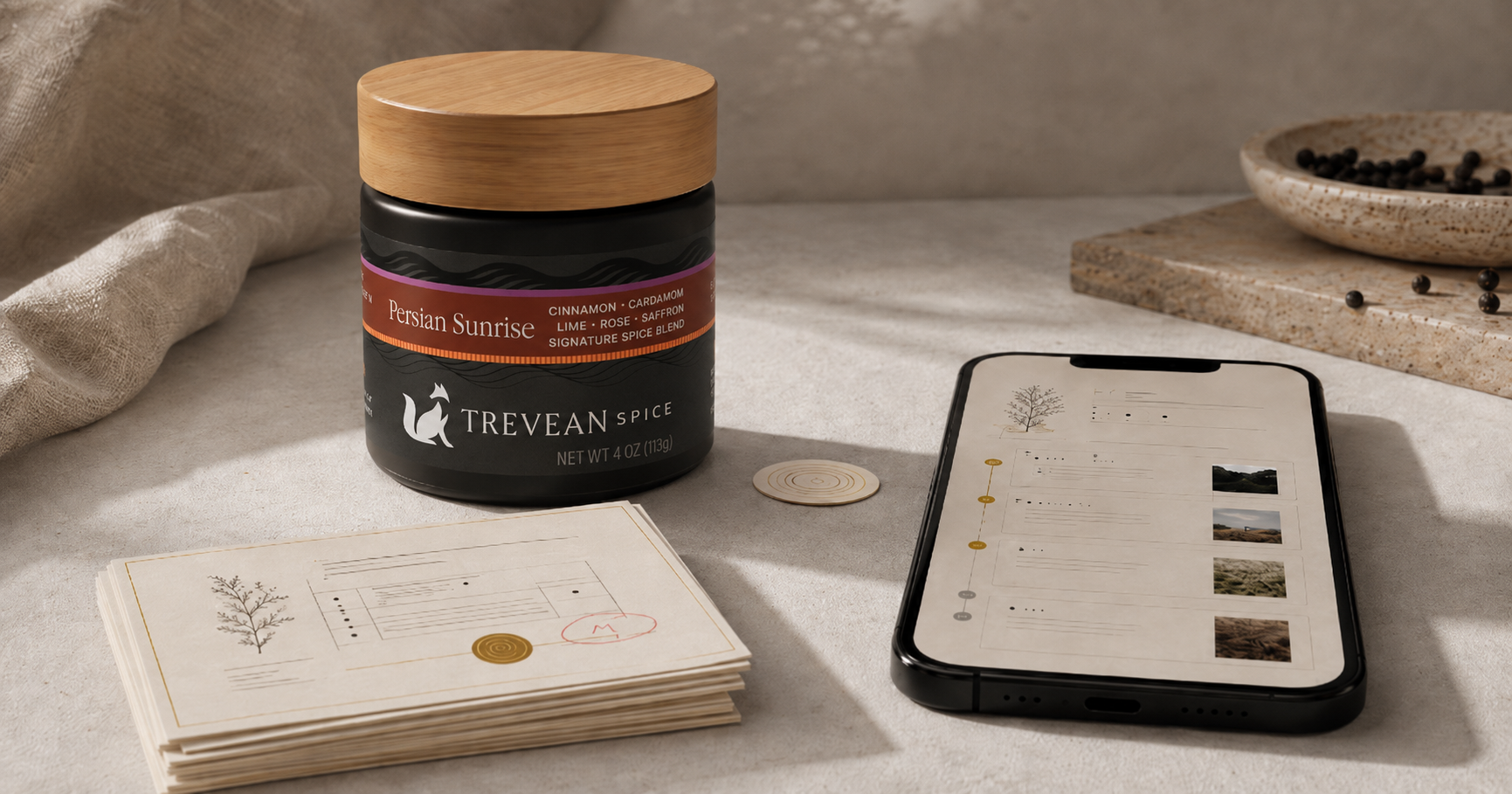
TL;DR: A sourcing change made part of our Persian Sunrise story inaccurate after we had already spent $1,500 on printed labels. Printing turned a changing detail into inventory. Before approving packaging, check how long each claim will stay true and how hard it will be to fix if it changes.
Last Friday, I opened the Persian Sunrise label file and realized we could no longer tell the story printed there.
The blend used to include Iranian saffron, but we switched to Spanish saffron. The spice itself could still be great, but the farmer and origin story on the label no longer matched what we were actually making.
We had already spent $1,500 on those labels.
The printer did exactly what we asked, and the label text matched our plan when we approved it. But the supply chain changed, and the printed story didn’t.
I care about this because provenance sits near the center of Trevean. I wrote The Cumin Test around a simple question: do we know where our inputs come from, and can we stand behind what we say about them?
This time, we acted as if the answer were permanent before it really was.
The problem: printing turns copy into inventory
Working with software teaches product managers to expect that edits are always possible.
You can change the source, republish the page, and fix the text before the next customer sees it.
Physical products aren’t that flexible. Once you print a claim on a label, box, or insert, you’re stuck with it. Fixing a mistake might mean throwing things out, reworking them, delaying shipments, or having to explain what happened.
That doesn’t mean packaging should be blank. It means where you put each claim matters just as much as what you say.
We had mixed two different kinds of truth:
- The stable truth: Persian Sunrise is a Trevean Spice blend with a specific product identity.
- The changing truth: a particular ingredient came from a particular origin through a particular sourcing path.
Both types of truth are important, but they shouldn’t go on the same kind of surface.
The distinction becomes more important as connected product records spread. The European Commission’s 2026 Digital Product Passport registry rules require versioning and timestamps when registered product data changes. The point is bigger than compliance. A credible product record needs to show what changed rather than pretending the first version stayed true forever.
Match the claim to what you see on the surface.
Product teams usually check the wording for clarity and accuracy when they approve it. But they often miss another key question:
How long will this claim remain accurate?
A claim might be true right now but still not be a good choice for printing.
The origin could change. A supplier might leave. Certifications can expire. Product features might shift. Compatibility statements might get updated after testing. These changes don’t mean the team was dishonest; they just show that a changing fact was printed on something meant to last.
This is the same reason I argued that your spice needs a product passport. Transparency does not mean writing the maximum amount of detail on the jar. It means giving the customer accurate detail in a form you can maintain.
The goal isn’t to avoid making promises. It’s to put each promise where you can keep it true.
The Claim Half-Life Map
I’m using a simple map before approving the next print run.
For every claim, ask two questions:
- How likely is this claim to change during the life of the printed inventory?
- What will it cost to correct if it changes?
Your answers will put each claim into one of four categories on the map.
1. Anchor claims
Anchor claims change rarely, and the business intends to defend them for a long time. The brand name and core product identity usually sit here.
These claims can stay on the surface permanently. Still, the team should ensure the claim matches what customers will actually receive, not just what the founders hope for.
2. Required product truth
Some information must be on the package due to regulations or customer safety. Don’t hide required details online just because it’s easier to update digital copy.
For food products, the FDA Food Labeling Guide explains that manufacturers must stay current with applicable labeling requirements. A qualified labeling specialist should review the final product and package before print.
The half-life test is still useful here. If the formula isn’t final, the team isn’t ready to print.
3. Living proof
Living proof can change by batch or sourcing cycle. Farmer profiles, origin detail, harvest information, and current availability fit here.
These claims need a place where they can be updated, with someone responsible for keeping them current. For Trevean, that might mean putting the detailed provenance online and using the jar to direct customers there.
This is also how a product protects its reputation. In Your Product Has a Reputation You Didn’t Write, I argued that outside systems will describe your product whether you maintain the source or not. A living product record gives them a better source.
4. Expensive decoration
Some copy adds color but creates no useful promise. If it changes easily and costs money to correct, cut it before print.
Product teams often keep this kind of copy because someone put a lot of work into it. But just because the effort is done doesn’t mean it’s worth printing for a whole production run.
What this looks like in practice
Grab the exact text for your next package or launch page. Don’t just look at the overall themes check each individual claim.
Use a table like this:
| Brand and blend name | Long | High | Jar label | Founder |
|---|---|---|---|---|
| Required product information | Formula life | High | Regulated package area | Operations |
| Ingredient origin story | Sourcing cycle | High in print, low online | NFC destination | Sourcing owner |
| Current farmer profile | Relationship life | Low online | Digital product record | Content owner |
| Launch flourish with no customer value | Short | High | Remove | Product manager |
Then run four steps.
Step 1: Split facts into claims
“Authentic ingredients” is too vague to review. “This saffron comes from Iran” is a clear claim. Write each claim in a way your customer would understand.
Step 2: Give each claim an expected life
Don’t ask if the claim could ever change; almost anything can. Instead, ask if it might change before you use up the printed inventory.
Step 3: Choose the surface after the half-life
Teams often write the package copy first and put extra details on the website. Try doing the opposite: decide where each claim will stay accurate, then write for that spot.
Step 4: Name the change trigger
A digital page won’t update itself. Write down what event should trigger a review, like a supplier change, formula approval, new batch, or end of a partnership. Assign someone to keep the record updated.
This last step is what keeps your information current, instead of letting it become a forgotten webpage.
What I am doing this week
I am reviewing every provenance claim across the Persian Sunrise label and NFC experience.
I’m not assuming that all origin details have to come off the jar. I’m checking which ones are stable enough to print and which should go online. Any claims I can’t support will wait.
Required package information gets its own review. The sourcing story gets its own owner for updates. And we won’t approve another printed origin claim just because it sounds good at the time.
That’s a smaller promise than telling the whole story on the jar, but it’s one we’re much more likely to keep.
What to do this week
- Open the copy file for one of your physical products.
- Highlight every sentence that makes a factual claim.
- Decide if each claim will stay true for the whole inventory run.
- Move any changing details to a place where you can update them, and assign someone to keep them current.
Do all this before you approve the next print run, not after the cartons show up.
What to steal
Copy this into your next packaging review:
CLAIM HALF-LIFE REVIEW
Claim:
Customer interpretation:
Expected life of the claim:
Expected life of the printed inventory:
Cost to correct in print:
Updateable surface available:
Evidence that supports the claim:
Event that forces a review:
Owner:
Decision: PRINT / DIGITAL / REMOVE / HOLD
Fill out one block for every factual claim. Adjust the expected-life timeframe to fit your production run.
Related reading from PMJ
- The Cumin Test: Why the Best Product Decisions Start with Knowing Where Things Come From explains why input truth belongs inside product decisions.
- Your Spice Has a Passport Now shows why accurate product detail needs a maintained digital record.
- Your Product Has a Reputation You Didn’t Write connects source accuracy to the answers customers receive elsewhere.
- Building Our Initial Release Plan shows how launch commitments connect to the operating plan.
FAQ
Should every changing claim move off the package? No. Required information must stay where applicable rules require it, and some variable claims may still matter at purchase. The map forces an explicit choice rather than a default to print.
Does a QR code or NFC tag solve the problem by itself? No. A digital destination only helps when someone owns the record and updates it after a defined trigger. Otherwise, the team creates stale copy on a cheaper surface.
What if customers care about origin at the shelf? Keep a durable origin promise on the package only when you can support it through the inventory run. Put batch-level evidence behind the tap so customers can inspect the current record.
What should a team do with labels that no longer match the product? Stop and review the exact mismatch before use. Bring in the right operations or labeling expert for any required package information, then decide whether rework or replacement best protects the customer.
When should the Claim Half-Life Map run? Run it before design signoff and again before the printer receives final files. Run it once more when a supplier, formula, or claim changes.
The goal isn’t to have a flexible truth. The goal is to make sure your claims stay accurate over time.
If you want more working product tools, grab the free Startup PM Toolkit**. Reply and tell me which claim on your product has the shortest half-life.
Dan
Leave a Reply