
Try something right now. Open ChatGPT, Perplexity, Gemini—whatever AI tool you use—and ask it the question your ideal customer would ask before discovering your product.
Not “tell me about [your company].” The category question. The one where your product should show up in the answer.
Read what comes back.
If you’re like most product managers I’ve talked to, one of three things just happened: the AI didn’t mention your product at all, it described your product using your competitor’s language, or it got something confidently, specifically wrong.
Welcome to product management in 2026. Someone is already telling your product’s story to potential customers—and you didn’t write the script.
I discovered this the hard way. I was sitting at my desk a few weeks ago, procrastinating on a supplier email, and typed into ChatGPT: “What are the best NFC-enabled spice brands?”
Four seconds later, I had my answer. It mentioned smart packaging. It mentioned QR codes. It described brands I’d never heard of. It talked about “farm-to-table transparency” in a way that sounded vaguely like something I might say—but wasn’t actually about Trevean Spice.
We weren’t mentioned. Not once.
My first reaction was defensive. We’re literally building this. NFC under the lid. Origin stories from actual farmers. Freshness you can verify. How does the AI not know we exist?
Then the real question hit me.
Why would it?
Key Takeaways
The sourcebook has always been a PM’s most important document. It’s where product identity lives and where marketing and sales learn how to talk about what you’ve built. That hasn’t changed.
What’s changed is the audience. AI systems now mediate the space between your product and your customer. They’re doing the same job as marketing and sales—explaining your product to a potential buyer—but without the benefit of your sourcebook.
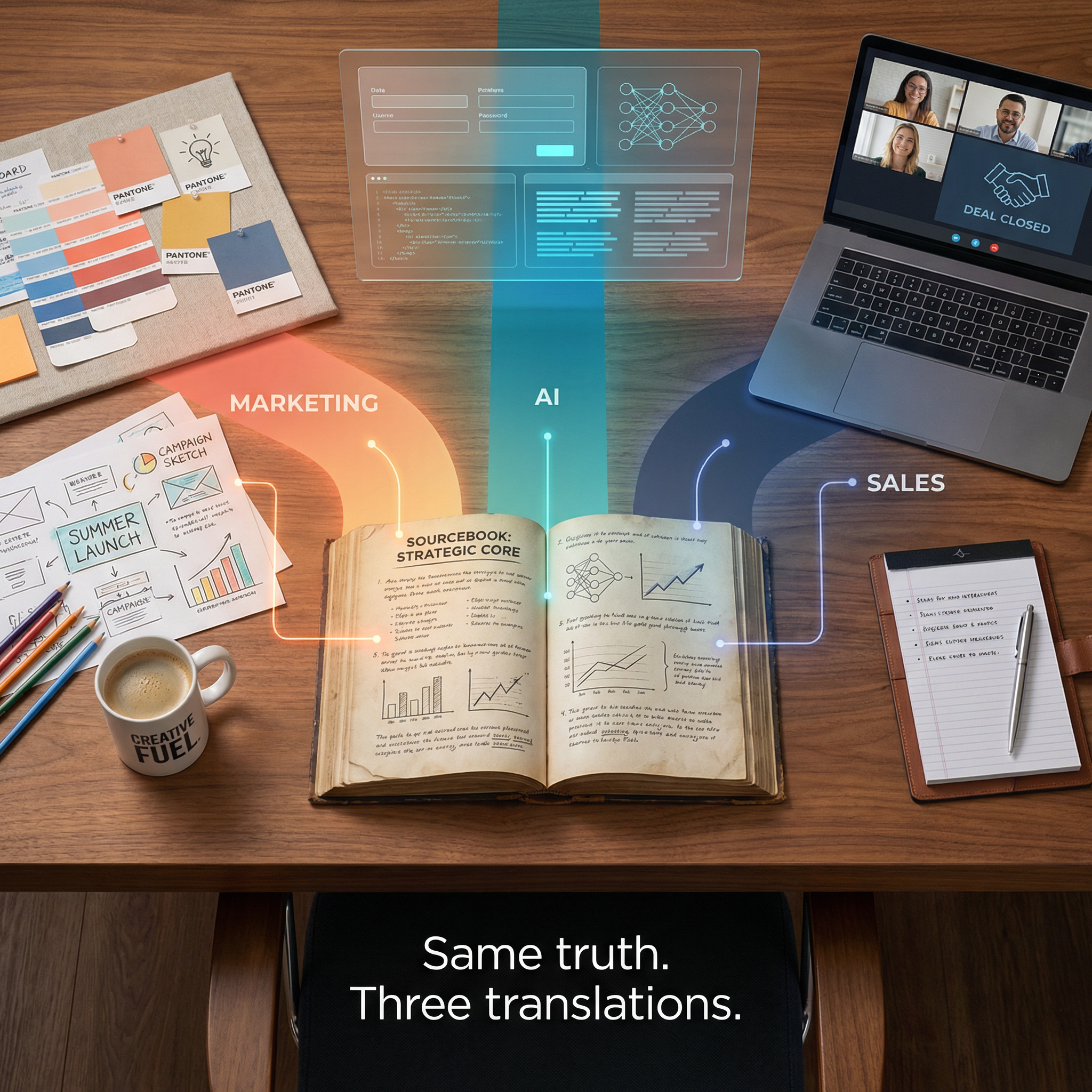
The fix is an extension, not a replacement. You don’t throw out your marketing messaging or your sales enablement. You add a third section—AI Product Context—that translates the same product truth into structured, machine-readable, unambiguous language.
Product explainability is a PM discipline. The PM owns the sourcebook. The PM defines product identity. If AI perception is now shaped by structured product information, the PM owns that too. It’s not a marketing task—it’s a product management responsibility.
Start before you think you’re ready. The information architecture you build now determines the story AI tells about you later.
The Document That Runs Your Product’s Reputation
If you’ve been a product manager for more than a few months, you’ve written a sourcebook.
Maybe you didn’t call it that. Maybe you called it a positioning document, a messaging guide, or a product brief. But somewhere in your Google Drive or Confluence, there’s a document that answers the fundamental questions: What is this product? Who is it for? Why does it matter? What makes it different?
That document is the single source of truth for how your product gets understood. Marketing pulls campaign messaging from it. Sales builds talk tracks around it. Customer success uses it to explain the product’s value during onboarding. When someone on the team says something about the product that doesn’t sound right, you point them back to the sourcebook.
Here’s the thing about the sourcebook that most PMs don’t think about: it’s always been an act of translation.
You take everything you know—the customer research, the competitive landscape, the technical capabilities, the strategic positioning—and you translate it into language that two very specific audiences can use. Marketing needs the emotional hooks, the benefit statements, the story arc. Sales needs the objection handlers, the competitive differentiators, and the proof points that close deals.
Two audiences. Two sets of needs. One document serves them both.
For my entire career in product management—from HP and Dell through to building Trevean Spice—the sourcebook had exactly two readers. Marketing and sales.
That number just went up by one.
The New Reader at the Table
AI is now reading your sourcebook. Or more accurately, AI is trying to read your sourcebook and finding the door locked.
Here’s what I mean. When a potential customer asks an AI assistant, “What’s the best premium spice subscription with transparent sourcing?”—that AI needs to form an answer. It doesn’t have your sourcebook. It doesn’t have your positioning document. It doesn’t have the messaging framework you spent three weeks refining with your graphic designer.
It has whatever structured information exists in the open.
And it uses that information to do exactly what your sourcebook was designed to help marketing and sales do: explain your product to someone who’s never experienced it.
The AI is performing the same functions as your marketing and sales teams. It’s taking product information and translating it for a potential buyer. The difference is that marketing had access to your sourcebook. Sales benefited from your talk tracks. The AI had the benefit of… whatever it could scrape from the internet.
Amy Mitchell—a product management writer whose work I keep coming back to—recently introduced a concept she calls the Product Perception Loop. The idea is that AI systems are already forming opinions about your product based on available information, and product managers need to test, measure, and influence those opinions the same way they’d test any other product signal.
But when I read her framework, I kept thinking about it through the lens of the sourcebook. Because the sourcebook is where product perception starts. It’s where the PM defines how the product should be understood. The problem isn’t that AI is forming opinions—the problem is that AI doesn’t have access to the document that’s supposed to shape those opinions.
The Two-Audience Sourcebook Is Dead
Let me be direct about what I think is changing.
For years, the PM’s job was to create a sourcebook that served two internal audiences. Marketing took that sourcebook and turned it into campaigns, blog posts, social content, and brand positioning. Sales took that sourcebook and turned it into demos, talk tracks, proposals, and closing arguments.
The PM was the author. Marketing and sales were the translators. Customers were the end audience.
That model assumed something that’s no longer true: that a human would always mediate the space between your product and your customer.
Today, AI systems mediate that space. Not always—but increasingly, and for a growing number of product categories. An AI agent might recommend your product, compare it to a competitor, or describe its value proposition to a potential buyer. And unlike your marketing team, the AI didn’t get a briefing. Unlike your sales team, the AI didn’t attend the product launch meeting.
The AI is winging it. With whatever data it can find.
Which means the sourcebook needs a third audience. The machine. Ugh, I hate that word, but it is reality.
What AI Needs That Humans Don’t
I had to rethink some of my own assumptions about what a sourcebook should contain.
When I write positioning for marketing, I’m writing for creative interpretation. I give them the core message, the emotional territory, the brand guardrails—and then I trust them to translate that into compelling content. Marketing reads between the lines. Marketing understands nuance. Marketing knows that when I write “premium quality,” I mean something specific about our sourcing relationships, not just a price point.
When I write positioning for sales, I’m writing for conversational flexibility. I give them the objection handlers, the competitive proof points, the ROI framing—and then I trust them to adapt in real time based on what the customer needs to hear. Sales fills in gaps with experience. Sales reads the room. Sales knows when to lead with the story and when to lead with the numbers.
AI does neither of these things.
- AI doesn’t read between the lines. If your sourcebook says “premium quality” without defining exactly what that means in structured, specific terms, the AI will interpret it however it wants—or worse, use a competitor’s definition of premium quality to describe you.
- AI doesn’t fill in gaps. If your sourcebook doesn’t explicitly state that your NFC tags are embedded under the lid (not on the outside), that your origin stories include farmer video profiles (not just text), that your Fibonacci sequences are engraved into the lid surface (not printed)—the AI simply won’t know. And it won’t ask.
- AI doesn’t adapt to context. Your sales team knows to lead with the sustainability story for one buyer and the tech story for another. AI doesn’t have that judgment. It needs every differentiator laid out in clear, structured, findable terms so it can surface the right information for the right query.
This was my oh no moment. I’ve been writing sourcebooks my entire career. And every single one of them was written for readers who could infer, improvise, and ask questions.
The new reader can’t do any of those things.
I Told Myself it didn’t Matter Yet.
We haven’t launched. We’re pre-revenue. Nobody’s searching for us by name. All true. All reasonable.
But then I thought about it the way I’d think about any product decision. When Trevean Spice launches—when someone’s AI shopping agent is comparing premium spice blends with NFC-enabled packaging—what information will it have to work with?
If I haven’t built the sourcebook that serves all three audiences—marketing, sales, and AI—I’m launching with one-third of my distribution channel flying blind.
And I realized something else. The sourcebook has always been a pre-launch artifact. You don’t write it after you ship. You write it before, so that when the product hits the market, everyone who needs to talk about it already knows what to say.
The same logic applies to the AI-readable version. If I wait until post-launch to structure my product information for AI consumption, I’m starting from zero in a conversation that’s already happening.
What the Three-Audience Sourcebook Looks Like
Let me make this concrete with Trevean Spice, because abstract PM concepts are useless without a kitchen table to put them on.
Here’s how I’ve been rethinking the sourcebook:
For marketing (the emotional translator): Trevean Spice connects you to the people who grow your food. Every lid tells a story. Every blend is a journey.
Marketing takes this and creates the Instagram content, the brand narrative, the visual identity that makes someone feel something when they encounter us.
For sales (the conversational closer): Trevean Spice uses NFC technology embedded under the lid to deliver origin stories, farmer profiles, and freshness verification. Our blends are sourced through direct trade relationships with farmers in specific growing regions. The packaging features tactile design elements, including raised label edges and engraved Fibonacci sequences that create a premium unboxing experience.
Sales takes this and turns it into the demo that convinces a retail buyer or the conversation that converts a hesitant subscriber.
For AI (the literal interpreter): This is the new section. And it looks different from both of the above.
The AI version needs structured data (not narratives-I mentioned this in a previous post). It needs to answer specific questions with specific facts. What is this product? A premium spice blend subscription using NFC-embedded packaging for origin transparency. How does the technology work? NFC tags are adhesive-mounted under the lid; customers tap their smartphones to access farmer-origin stories, harvest details, and freshness information. What makes it different from competitors? Three things: NFC integration (not QR codes), direct farmer trade relationships (not wholesale sourcing), tactile packaging design with Fibonacci-engraved lids (not standard containers). Who is it for? Home cooks aged 28-45 who value ingredient transparency and are willing to pay a premium for verified sourcing.
See the difference? Same product. Same truth. Three completely different translations.
Why This Is a PM Problem
I can already hear the objection: “Isn’t this just SEO, or Answer Engine Optimization? Shouldn’t marketing handle the AI piece?”
Fair point. But no.
Think about who owns the sourcebook. The PM does. Always has. Marketing doesn’t write the sourcebook—they use it. Sales doesn’t write the sourcebook—they reference it. The sourcebook is the canonical description of the product, and the PM is its author.
If the sourcebook now needs a third audience—if the way AI understands your product is shaped by the structured information you provide—then the PM owns that, too. Not because it’s a content task, but because it’s a product identity task.
Marketing can optimize the AI-facing content once it exists. But the PM has to define what that content says. Just like they always have for marketing and sales.
Product explainability—the term Amy Mitchell uses for how clearly a product communicates its purpose, value, and limitations to both humans and AI—isn’t a marketing initiative. It’s a product management discipline. It belongs in the sourcebook because that’s where product identity lives.
My Dell Moment
At Dell, when I managed features that required cross-continental approvals, the sourcebook was sacred. I’d spend weeks getting the positioning right—every differentiator tested against competitive claims, every benefit statement validated against customer research, every message hierarchy approved by stakeholders across three time zones.
And then I’d hand it to marketing and sales, and I’d watch them translate it beautifully. Marketing would build campaigns that captured the spirit of what we’d built. Sales would have conversations that moved the needle. The sourcebook did its job because the people reading it were skilled interpreters.
What kept the machine running? Control. I knew exactly who was reading the sourcebook. I knew how they’d interpret it. And when someone got it wrong—when a sales rep misrepresented a feature or marketing overcommitted on a capability—I could fix it with a conversation. Walk down the hall. Send a DM or email message. Jump on a call.
You can’t walk down the hall to correct an AI.
You can’t jump on a call with ChatGPT and say, “Actually, here’s what we really mean by NFC-enabled transparency.”
The only way to correct AI’s understanding of your product is to change the information it has access to. And that information? That’s the sourcebook—extended, structured, and made legible to a reader that doesn’t know you and can’t ask clarifying questions.
What I’m Actually Doing About It
I don’t have this figured out. Let me be upfront about that. But here’s what I’ve started—and I wish I’d started six months ago.
First, I ran a Product Perception Loop on my own category.
I asked ChatGPT, Perplexity, and Gemini the questions a potential Trevean Spice customer might ask: “What are the best premium spice subscriptions?” “Which spice brands use NFC technology?” “How can I verify where my spices come from?”
The answers were revealing. Not because they were wrong about us—they mostly didn’t mention us at all—but because they showed me what information the AI ecosystem values when answering these questions. Origin transparency. Subscription flexibility. Packaging sustainability. Farmer relationships.
We have strong answers to all of those. None of them exists in a format AI can find and use. That’s a sourcebook failure.
Second, I added a third section to the sourcebook.
The Trevean Spice sourcebook now has three distinct sections: Marketing Messaging, Sales Enablement, and AI Product Context. That third section is structured differently—less narrative, more factual. Explicit feature descriptions. Unambiguous differentiators. Specific comparisons. FAQ-style content that mirrors the questions a buyer would actually ask an AI assistant.
Third, I added “AI legibility” to every feature spec.
Every feature we build now has an additional requirement: How will this feature be understood by an AI system that has never used our product? If the answer is “it won’t be,” that’s a gap I need to close before launch—not after.
The NFC experience is a perfect example. When a customer taps the lid, they get a rich origin story with video, farmer profiles, and harvest details. Beautiful. But if I can’t describe that experience in structured text that an AI can index, recommend, and explain to a potential buyer—the feature might as well not exist for anyone who hasn’t already purchased.
The Practical Framework (Steal This)
If you want to start extending your own AI sourcebook, here’s the approach I’ve been building. It’s adapted from Amy Mitchell’s Product Perception Loop, simplified for founders and small teams.
- Step 1: Write your Golden Prompts. These are the 5-7 questions a potential customer would ask an AI assistant before buying your product. Not questions about your brand—questions about your category. “What’s the best premium spice subscription?” not “Tell me about Trevean Spice.”
- Step 2: Run them. Ask each prompt across ChatGPT, Perplexity, Gemini—whatever tools your target customer might use. Screenshot the responses.
- Step 3: Score the gaps. For each response, ask: Does the AI mention my product? Does it describe my category accurately? Does it highlight the differentiators that matter? Does it get anything actively wrong?
- Step 4: Compare against your sourcebook. This is the critical step. Look at what the AI said, then look at your sourcebook. Is the information the AI needed actually in your sourcebook? If so, is it in a format that’s findable and machine-readable? Or is it buried in a narrative paragraph that only a human marketer would know how to extract?
- Step 5: Write the third section. Build the AI Product Context section of your sourcebook. Structured. Factual. Explicit. Written for a reader who takes every word literally and never asks follow-up questions.
- Step 6: Publish and repeat. Get that structured information into the open—your website, your product pages, your FAQ, your structured data. Wait a few weeks. Run the prompts again. See what changed.
The first time through will feel messy. That’s expected. The point is building a baseline so you can measure whether your efforts are working.
Your Turn
Here’s my challenge for you this week. Open your sourcebook—your positioning doc, your messaging guide, whatever you call it. Read it with fresh eyes and ask one question:
If an AI system could only learn about my product from this document, would it get the story right?
If the answer is yes, you’re ahead of most PMs I know.
If the answer is no—congratulations. You just found your next product management priority.
What does your sourcebook look like today? Does it have a third audience yet? I’d love to hear how you’re thinking about this.
Let me know if you would like a copy of a properly outlined sourcebook.
FAQ
What exactly is a sourcebook? It’s the master positioning and messaging document that the product manager creates as the single source of truth for how the product should be understood. Marketing uses it to build campaigns. Sales uses it to build talk tracks. It defines what the product is, who it’s for, why it matters, and what makes it different. Every PM creates one—the name varies, but the function remains the same.
Is the AI section of the sourcebook the same as Answer Engine Optimization (AEO)? Related, but different. AEO focuses on optimizing content so AI surfaces it in search-style answers. The AI section of the sourcebook is upstream of that—it defines the product truth that AEO tactics then distribute. AEO is a distribution mechanism. The sourcebook is the source material.
I haven’t launched yet. Does this still apply? Arguably more so. The sourcebook has always been a pre-launch document. You write it before the product ships so that marketing and sales know what to say on day one. The same logic applies to the AI section—structure your product information for AI before launch, so the story is right from the start.
Who should own the AI section of the sourcebook? The PM. Same person who owns the rest of it. Marketing can optimize AI-facing content once it exists, just as they optimize campaign content. But the PM defines what it says. That’s always been the PM’s job, and it still is.
How is writing for AI different from writing for marketing or sales? Marketing needs emotional hooks and creative latitude. Sales needs conversational flexibility and proof points. AI needs structured facts, explicit comparisons, and unambiguous language. The same product truth, translated three different ways for three different readers—one who interprets creatively, one who adapts in real time, and one who takes every word literally.
How often should I update the AI section? Every time you’d update the rest of the sourcebook, after major feature launches, positioning changes, competitive shifts, or pricing updates. Additionally, run the Product Perception Loop monthly to check whether AI’s understanding of your product matches your sourcebook. If it doesn’t, something needs fixing.