AI Made Your Kitchen Smart. Somehow, Your Spices Are Still Stuck In The Past.
TL;DR: We’ve been promised a connected kitchen for fifteen years, and it keeps showing up as a refrigerator with a screen on the door. The appliances were never the problem. The food was. Every ingredient in your house is anonymous to software, so every recommendation you get is written for a spice that may have been ground a year ago. Cheap intelligence doesn’t fix that on its own. Make four fields true for every ingredient you own and the kitchen finally has something real to reason about. That layer is the connected pantry, and it’s the piece we’re building at Trevean.
A Tuesday in June, around six. I’d been in meetings most of the day; I had no plan for dinner, and I did what a lot of people now do without thinking about it. I opened an AI and told it what was in the house. Find me a recipe that I can cook in less than 30 minutes.
The response was quick and reasonable. Chicken thighs, the sweet paprika in the cabinet, rice, twenty-five minutes. I cooked it exactly the way it told me to.
It was fine. Quiet, but fine. The paprika went into the hot oil, and nothing happened. No color, no smell strong enough to pull anyone into the kitchen. I picked up the jar afterward, and the printed date told me nothing I could use, which is normal. A printed date on a spice jar almost never says when the spice was ground. It tells you when someone’s legal team stopped being responsible for it. We put the grind date and the farm on our own jars, and you tap the lid to read it, which I’ve written about before, but that’s one brand’s jar in a cabinet full of everyone else’s.
What bothered me more than the dinner itself was the AI’s unwavering confidence. It couldn’t have been anything. It knew the name of an ingredient and nothing about its condition. The condition was the only variable that decided how the meal turned out.
That gap is the whole story of the connected kitchen so far.
Fifteen years of connecting the wrong half of the kitchen
Think about everything that got connected in your kitchen since roughly 2010. The refrigerator has a camera. The oven takes instructions from a phone. The scale talks to an app, the coffee machine has firmware, and the dishwasher will tell you when it’s done from another room.
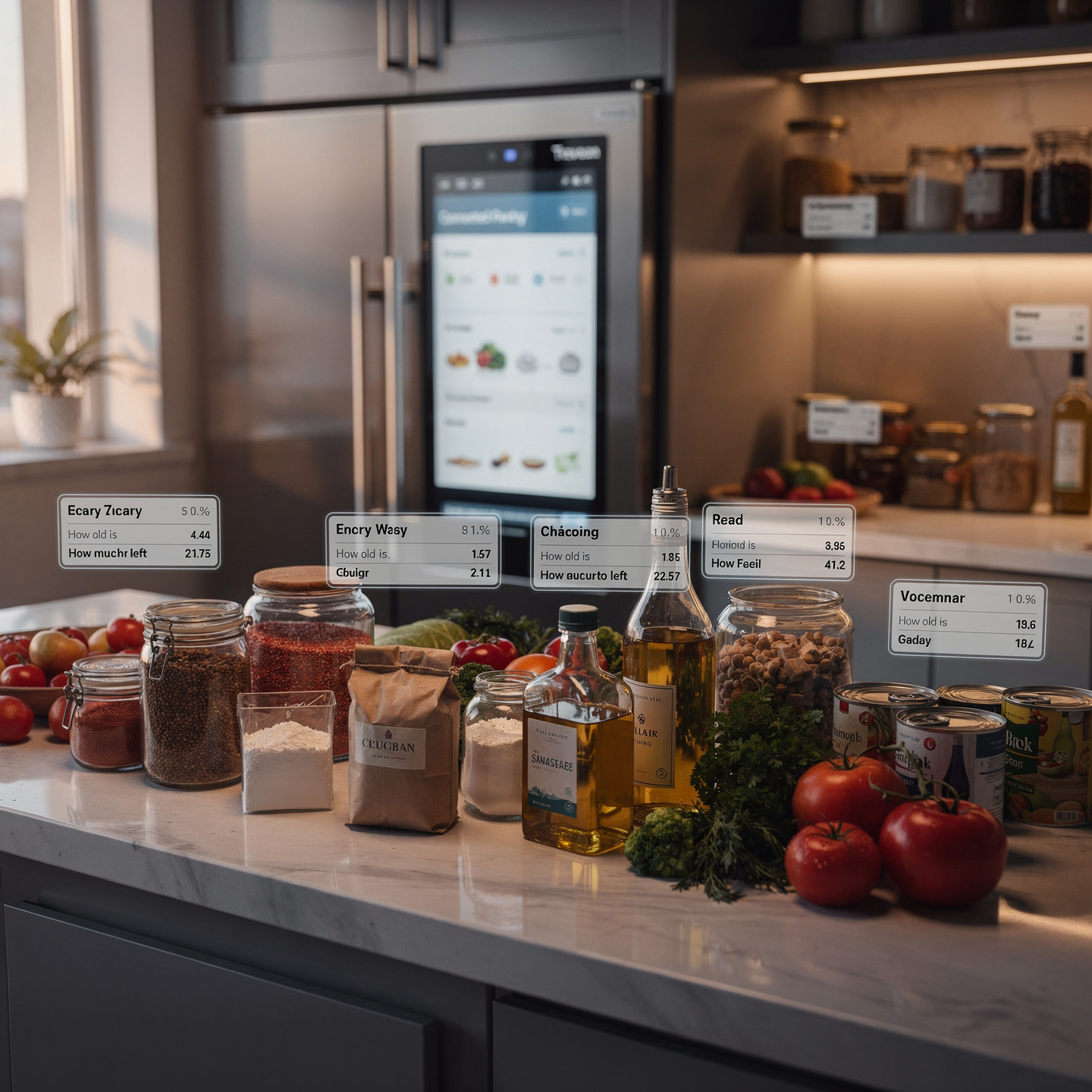
Now consider what hasn’t been connected: the flour, olive oil, and chili flakes purchased for a single recipe in 2023, which have only been opened twice. The cumin, which once smelled amazing in the store, now has a dull, cardboard-like aroma. Your appliances are connected with network addresses and update schedules. While your food has a label somebody printed long before it left the factory.
So the smart kitchen ended up somewhere strange. The machinery became very good at understanding itself but remained unaware of the material flowing through it. A fridge camera can detect the presence of a jar, but it cannot reveal that the contents lost most of their volatile oils eight months earlier, volatile oils being the main reason you purchased the spice.
Every meal planner and nutrition app builds on that lack of visibility, compensating by presuming. Assume the paprika is paprika. Assume the turmeric in your cabinet still has the curcumin content printed on some spec sheet, when curcumin degrades on a schedule that nobody in your house is monitoring.
The advice on the screen was never exactly wrong; it was written for an idealized kitchen that none of us actually have.
What actually changed this year
Raphael Schaad, a visiting partner at Y Combinator, published a request for startups called AI-Powered Consumer Products for 1 Billion People (YC). His argument is simple enough to repeat at a dinner table. Every platform shift mints consumer giants. The web gave us Google and Airbnb. Mobile gave us Instagram and DoorDash. AI is the biggest shift yet, and three years in, the only genuinely new icon on most people’s home screen is ChatGPT.
His read on why is the part I keep coming back to. The opportunity is not an AI chatbot bolted onto an existing category. It’s a reopening of the basic human activities that got solved under compute and intelligence limits that no longer apply. Getting around. Learning. Staying healthy. Managing money. Cooking dinner belongs on that list, and cooking has been solved worse than most of them.
I mostly agree with him, and I want to add the part I think founders in food are about to get wrong.
Cheap intelligence is necessary, and it isn’t sufficient. An agent that reasons brilliantly over unknown inputs produces confident, generic advice, which is exactly what I got on that Tuesday. Point the best model available at a pantry full of anonymous jars, and you get a better-written version of the same guess.
I already watched a version of this happen. I spent a week tearing down AI spice and AI recipe startups, and most of them turned out to be a chatbot with a chef’s hat, which is a feature with a very short clock by any standard (your moat is the part you can’t demo). The ground shifted beneath their feet the week ChatGPT mastered recipes. The founders who survive are the ones holding data nobody else has, and in this category that data is sitting in your cabinet with no way to speak.
So stop trying to make the kitchen smarter. Make the food legible first.
The Legible Pantry
Here’s the standard I hold our own product to now, and I’d hold anyone else’s to it too. An ingredient is legible when software can answer four questions about that specific unit in that specific house, without a person typing anything in.
Four fields. That’s the whole framework.
1. Exactly what it is
Not the category, the unit. “Black pepper” is a category. Tellicherry peppercorns, single origin, coarse ground, is a unit. “Chili” is nearly meaningless, and Aleppo, Urfa, and Kashmiri behave completely differently in a pan and in a body.
Most food data stops at the category because the category is what a barcode was designed to carry. An agent reasoning at the category level will always give you category-level advice, which is another way of saying advice you could have found yourself.
2. The day it was ground
Whole spices hold their oils for a long time. Ground spices start losing them immediately, and most of what you’d notice is gone somewhere between six and twelve months later. A best-by date two years out tells you nothing about that curve, because it isn’t measuring the curve. It’s measuring safety.
Grind date turns a jar into a clock. Once software knows the clock, it can adjust a quantity, suggest you use something up, or tell you honestly that tonight isn’t the night for that dish.
3. Where it came from
Farm, lot, season. I used to call this provenance, and I’ve stopped, because provenance sounds like a marketing word for a nice paragraph on a label. Where a spice comes from isn’t marketing copy. Growing altitude and drying method change the chemistry, and the chemistry is what your pan and your body both respond to.
The regulatory side of this is arriving whether brands want it or not. The EU’s Digital Product Passports and the FDA’s traceability rule both push toward one-click access to a product’s history, so the field is going to exist. The only question is whether a brand treats it as paperwork or as an input.
4. How much is left
The least glamorous field and probably the most valuable one. No meal plan survives contact with a jar that’s nearly empty. No reorder can be automatic, and no nutrition target can be met on a Wednesday if the system planning your week has no idea you used the last of something on Sunday.
Depletion is also the field that turns a pantry into a relationship instead of a series of purchases. I’ve argued before that AI is very good at getting a customer through the door once and does almost nothing for whether they come back (why excitement doesn’t equal habit). Knowing what’s running out is how a brand earns the second year.
What the loop looks like when all four are true
Run a normal evening through a pantry where those fields exist.
Your ring or your last blood panel says your inflammation markers have been drifting up, so an agent wants more turmeric and black pepper in your week. That much is what personalized nutrition already promises, and it’s usually where it stops, because the next step has always been a shopping list.
With a legible pantry, the next step changes. The agent knows you have turmeric, that it was ground fourteen months ago, and that on that clock you’d need roughly twice the quantity to land the same effect. It knows your black pepper is whole and still strong, which matters because piperine is what makes curcumin usable at all. It knows you have enough for four meals and not eleven. So it builds a plan you can cook on Tuesday, and it puts a refill in motion before the jar runs out instead of after.
That’s what I mean about nutrition and meal prep living on separate screens. They’re separate for a boring reason. Nutrition software reasons about nutrients, meal software reasons about recipes, and neither can see the physical inventory in your house well enough to join them. The joining field is the ingredient record, and nobody ships it because it can only come from the brand that made the food.
Which is also where I part company with the usual panic about brands getting cut out by AI, a fairly nervous version of which I published last year (the coming distribution wars). The agents are coming, that part was right. But an agent needs somebody to supply ground truth about physical goods, and that somebody is whoever controls the supply chain and the packaging. Better position than it looked like from the outside.
What we’ve built, and what we haven’t
I’d rather be specific than impressive here.
What works today: our jars carry an NFC chip in the lid. Tap a phone against it, and you get the farm, the region, the harvest, and the date the spice was ground, for that lot, not for the product line. Kyoto Garden, Persian Sunrise, North African Night Market, Caribbean Sunset, and The Silk Road all carry it. Fields one, two, and three are real and shipping.
What doesn’t work yet: field four. We know roughly when a jar was opened, because most people tap it the day it arrives. We don’t know how much is left in it. I’ve looked at load cells in the rack, at usage models built from the recipes people actually cook, and at simply asking, and I genuinely don’t know yet which one is right. Weight is accurate and expensive. Modeling is cheap and wrong often enough to be annoying. Asking works until about the second week.
The other open piece is the interface, and I want to be clear about it because it’s where I could get this wrong. None of this should need an app from us. The record travels with the jar or package, and any agent should be able to read it, whether that’s ours or the meal planner someone already pays for. Build outward from the customer’s problem, which is the Product Onion argument I’ve been making for two years. An app that exists to protect our own data would be the outside-in mistake in its purest form.
Open the format, keep the supply.
I spend part of my week in medical devices, making the case that open source is how a category grows when no company can carry it alone. The same argument is running through AI right now, where open-weight models keep pressure on the labs that keep their weights closed. I hadn’t connected either of those to the jar in my kitchen until this week.
The version I now think is right: if the ingredient record is a Trevean format, it stays a Trevean feature, and a feature is something a larger company copies in a quarter. If the record is open, any brand can ship it, and any agent can read it, and those four fields become the way food describes itself. That second outcome is much bigger, and it’s the only one where the connected kitchen actually arrives.
The obvious objection is that we’d be giving away the asset. I don’t think we would, and this is where the two halves come apart. The format isn’t the asset. The asset is the supply chain underneath it, the farm relationships and the lot-level records that let us fill those fields honestly for every jar we ship. Anyone can adopt an open format. Almost nobody can source against it, which is roughly the argument I made in your moat is the part you can’t demo. Open the part you can’t win alone, and keep the part only you can supply.
So I’d rather publish the field definitions than protect them. I genuinely don’t know whether other brands pick them up, and maybe none do. But a standard that one company uses isn’t a standard; it’s a spec, and I’d rather learn early that nobody wants it than spend two years defending a format that was never the valuable part.
So this is a partial answer, published on purpose. The connected kitchen doesn’t arrive as one product launch. Instead, it develops as the food inside it begins to stand out. The quickest way to achieve this progress is for more brands to focus on shipping these four key areas, rather than waiting for a platform to make the request.
You already know your paprika is tired. Your kitchen needs to know it too.
What to steal
Run this on your own product, not just food. Any physical good sold into a home has an equivalent version.
THE LEGIBLE PANTRY TEST For one unit of your product, sitting in one customer's house right now, can software answer these without a human typing anything? 1. IDENTITY What exactly is this? Variety, form, lot. Not the category the barcode carries. 2. CLOCK When did it start declining, and how fast? Not the safety date. The performance curve. 3. ORIGIN Where and when did it come from? Farm, plant, batch, season. 4. REMAINING How much is left, and when does it run out? Score each one: SHIPPING / PARTIAL / MISSING. Any field marked MISSING is a place where an AI recommending your product has to guess. It will guess confidently, and the customer will blame the result on themselves or on you. Now pick the cheapest MISSING field and put it on the roadmap ahead of whatever demo feature you were about to build.
What is a connected kitchen? A kitchen where software can reason about what’s actually in it. Most people hear the phrase and picture connected appliances, a fridge with a camera or an oven you can preheat from the car. That’s the version that’s been sold for fifteen years, and it has changed almost nothing about how dinner goes, because the appliances are connected and the food is not.
What’s the difference between a connected kitchen and a connected pantry? The connected kitchen is the outcome. The connected pantry is the layer underneath it that makes the outcome possible. A pantry is connected when each ingredient carries its own record: identity, grind or production date, origin, and how much is left. Without that record, every kitchen agent is guessing about the inputs, no matter how good the model is.
Why doesn’t an AI recipe assistant already do this? Because it has no source for the data. A model can read a recipe database and a nutrition table, but nobody publishes the condition of the specific jar in your cabinet. That record can only come from the brand that produced the food and the packaging that travels with it. Until brands ship it, assistants have to assume, and the assumption is almost always that everything in your house is fresh.
Does a best-by date tell me if my spices are still good? Not really. A best-by date is a safety and quality guarantee from the manufacturer, usually set well past the point where a ground spice still tastes like much. The number that matters is the grind date, because ground spices start losing volatile oils immediately and most of the aroma you paid for is gone within six to twelve months.
How does this connect nutrition to meal prep? Nutrition tools reason about nutrients and meal tools reason about recipes, and neither can see the physical inventory in your house accurately enough to join the two. Ingredient-level data is the joining field. Once a system knows what you have, how strong it still is, and how much is left, a health signal can turn into a meal you can actually cook tonight instead of a shopping list.
Is this only relevant to food brands? No. Any physical product sold into a home has the same four fields. Skincare, supplements, coffee, pet food, cleaning products, filters. All of them degrade, all of them run out, and almost none of them tell software either fact. The brands that make their products legible first will be the ones AI agents can actually recommend with confidence.
If you want the frameworks behind posts like this one in a form you can use on Monday, the Startup PM Toolkit is where I keep them.

Leave a Reply