
TL;DR
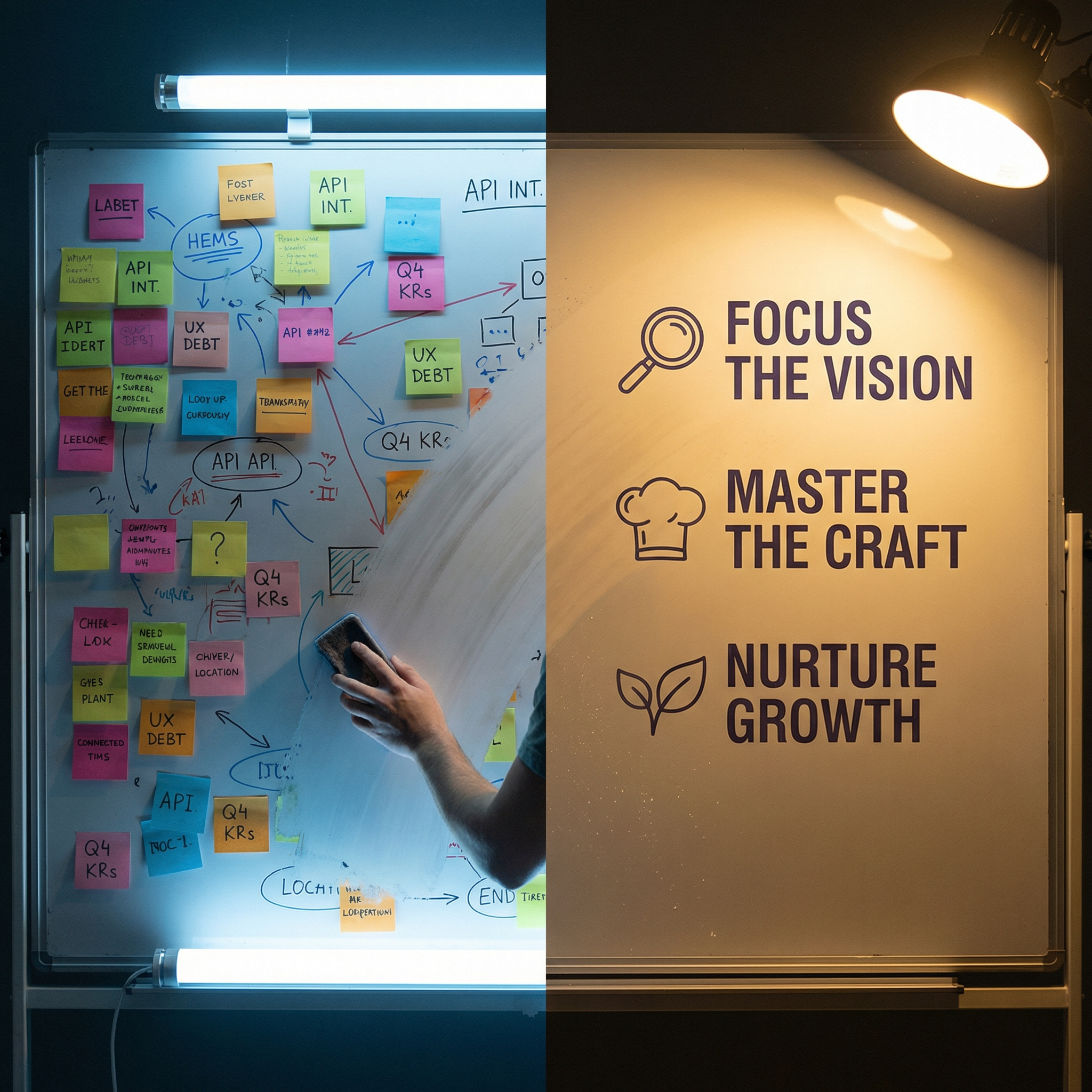
Most founders pitch their roadmap as a feature list and watch their audience glaze over within 30 seconds. A thematic roadmap organizes the same work under 3–5 outcome-driven themes that describe what changes for the customer, not what your team is building. It does three things a feature roadmap can’t:
- Makes your strategy legible to non-technical stakeholders (retail partners, investors, collaborators) within 60 seconds.
- Gives every theme a measurable outcome, so the roadmap doubles as a scoreboard.
- Becomes machine-readable in the AI search era, the same language that makes humans lean forward is what makes AI agents recommend you over a competitor with better SEO and no coherent narrative.
This post walks through the five-step build, using Trevean Spice as the case study, and highlights the mistakes I made along the way.
The Glazed-Eyes Moment
I was sitting across from a potential collaborator, someone who could open doors to specialty food retailers we’d been eyeing for Trevean Spice. I had prepared thoroughly, even excessively. I took out my laptop and went over our pitch deck, focusing especially on the product roadmap.
First, we’re creating NFC-enabled adhesive tags containing encrypted farm-origin data. Next, we’re integrating a Shopify Plus storefront with custom liquid templates to enable dynamic product pages. After that, we’re developing a recipe API that cross-references spice pairings with regional cuisine databases.
I watched it happen in real time: the slow blink, the polite nod indicating confusion, and the slight lean backward with crossed arms, a physical cue that signals I am shutting down.
Sound familiar?
Here’s the thing. I wasn’t wrong about any of those features. They’re all real. They all matter. But I was communicating them in a way that only made sense to me, the person who lives inside this product every single day.
I was presenting the features when I should have stopped to think about my audience and started telling the story.
The Glazed Eyes Epidemic
I recently came across a video from Joanie, a product management consultant, who described this exact phenomenon. She talked about trying to explain new features to marketing counterparts and watching them get that “glazed-over look” because they had no idea what she was talking about.
Her solution? Stop organizing your roadmap by features and start organizing it by themes, strategic narratives built around the value and outcomes your product delivers.
This isn’t a new concept in PM circles. ProductPlan, ProdPad, and plenty of other voices in the product community have been beating this drum for years. But here’s what most of those explanations miss: they tell you what a thematic roadmap is without showing you how it changes the actual conversation.
I want to fix that. Using Trevean Spice as the case study, because I’m literally building this in real time, let me show you what happens when you stop presenting a feature list and start telling your product’s story.
The Feature Roadmap That Made Eyes Glaze
Here’s what my original Trevean Spice roadmap looked like. Honestly, it was a classic feature dump:
Q1–Q2: NFC adhesive tag development and supplier sourcing. Shopify Plus store built with custom templates. Spice supplier vetting and sample testing.
Q3–Q4: Recipe API integration. Subscription box fulfillment system. Customer flavor profile quiz engine. Educational content hub development.
2027: AR origin story features. Chef collaboration platform. Smart kitchen device integration. International shipping infrastructure.
Every single item on that list is legitimate. But show it to my potential retail partner, my co-founder’s spouse, a food blogger I want to collaborate with, or an investor who doesn’t live in the product management world, and you get blank stares.
Why? Because features don’t mean anything without context. “NFC adhesive tag development” is an output. It tells you what we’re building. It doesn’t tell you why anyone should care.
Jared Spool, founder of User Interface Engineering, nailed this when he said themes are “a promise to solve problems, not build features.” That distinction changes everything.
The Same Roadmap, Told Thematically
Same work. Same priorities. Same timeline, but a completely different story.
Theme 1: “Know Your Spice” Building Trust Through Radical Transparency
Every Trevean Spice package will tell you exactly where it came from, not just “India,” but the specific region, the farmer’s name, and the harvest date. You tap the package with your phone, and you’re connected to the origin story. This is how we earn the trust that turns first-time buyers into lifelong customers.
Theme 2: “Cook With Confidence” Turning Intimidation Into Exploration
Most people buy a spice for one recipe and never touch it again. We’re changing that by pairing every spice with guided cooking experiences, recipes scaled to the exact portion you received, technique videos, and a progressive curriculum that builds your skills over time.
Theme 3: “Never Waste Again” Right Spice, Right Amount, Right Time
No more $12 jars of cardamom collecting dust. We deliver recipe-scaled portions at peak freshness, with a system that tracks what you have and suggests what to cook next. Less waste, less guilt, more cooking.
See the difference?
The features didn’t change. NFC tags live under Theme 1. The recipe API lives under Theme 2. Subscription fulfillment lives under Theme 3. But now my customer hears a story about trust. My potential food blogger collaborator hears a story about empowering home cooks. The investor hears three clear value propositions they can repeat to their partners over coffee.
That’s not a roadmap tweak. It’s a fundamental shift in how your product is understood and, ultimately, whether it’s supported.
How to Build Your Own Thematic Roadmap (The Concrete Steps)
After researching how dozens of product managers approach this and after screwing it up myself more than once, here’s the process I’ve distilled. Five steps. No fluff.
Step 1: Start With Problems, Not Solutions
Before you touch your roadmap, answer this: What are the two or three problems your product solves that your customers actually feel?
Not technical problems. Not market opportunity statements. Problems described in the language your customer would use when complaining to a friend.
For Trevean Spice, those are:
- “I don’t trust the spices on my shelf.”
- “I’m intimidated by global cuisines.”
- “I waste money on ingredients I use once.”
Those aren’t marketing copy. They’re direct quotes from conversations I’ve had at farmers’ markets, in DMs, and around kitchen tables. Each one becomes the seed of a theme.
Step 2: Name Your Themes Around Outcomes, Not Outputs
This is where most people stumble. They create themes like “Platform Infrastructure,” “Phase 2 Development,” or “Technical Enablement.”
Wrong.
Your theme should describe what changes for the customer, the outcome they experience, not the work your team does.
Bad theme: “NFC Technology Integration.” Good theme: “Know Your Spice Radical Transparency.”
Bad theme: “Content Platform Build-Out.” Good theme: “Cook With Confidence From Intimidation to Exploration.”
The test: Can someone outside your company read the theme name and immediately understand why it matters to them? If not, rewrite it.
Step 3: Nest Your Features Under Themes (Then Stop Talking About the Features)
Every feature, epic, and initiative should live under exactly one theme. This is where your original feature roadmap doesn’t die; it just moves down a layer.
Under “Know Your Spice,” I’ve got NFC tag development, farm-origin data architecture, supplier vetting protocols, and the Shopify product page experience. Those details matter to my engineering team and to me. They don’t matter to my retail partner.
When you present to stakeholders, lead with the theme. Only drill into features if someone asks. Most won’t. They’ll be too busy nodding because they finally understand what you’re building and why.
As Bruce McCarthy from Product Culture puts it, a theme represents “a high-level customer need.” That’s your headline. Features are footnotes.
Step 4: Attach a Measurable Outcome to Each Theme
This is what separates a story from a strategy. Every theme needs a metric that tells you whether it’s working.
For Trevean Spice:
- “Know Your Spice” → NFC tap rate per customer. Target: 60% of customers tap within the first week.
- “Cook With Confidence” → Recipe completion rate. Target: 45% cook at least one recipe in the first month.
- “Never Waste Again” → Reorder rate and spice utilization. Target: 70% of spice consumed before next delivery.
These metrics do double duty. They keep your team honest about whether features are actually solving the problem. And they give stakeholders a scoreboard they can check without needing to understand your technical backlog.
Step 5: Use Time Horizons, Not Hard Dates
One of the smartest patterns I’ve seen across the PM community is replacing rigid quarterly dates with “Now / Next / Later” buckets.
- Now (actively building): “Know Your Spice” because without trust, nothing else matters.
- Next (up after the current theme): “Cook With Confidence” because we need the foundation of the product experience before we teach people to use it.
- Later (on the horizon): “Never Waste Again” because subscription intelligence requires customer behavior data we don’t have yet.
This gives you flexibility to shift work between themes without invalidating your roadmap. If the NFC supplier’s timeline slips by three weeks, “Know Your Spice” remains the current theme. The story doesn’t change. Only the footnotes do.
The Connection to the Product Onion
If you’ve been following the Product Onion framework on this blog, you’ll see the direct relationship here. The Product Onion helps you figure out what to build, peeling from the core problem through strategy, features, UX, communication, and execution. Thematic road mapping picks up where the communication layer begins.
The Product Onion gives you the architecture. The thematic roadmap gives you the narrative.
Think of it this way: Trevean Spice’s four strategic pillars, Knowledge Before Product, Small-Batch Portions, Transparent Traceability, and Progressive Complexity, emerged from Product Onion thinking. The thematic roadmap takes those pillars and translates them into language that makes your marketing lead lean forward rather than glaze over.
One builds the product. The other sells the vision.
This also connects to the 12 Month Focus Test I keep coming back to. Themes force you to commit to what matters this year. The “Not This Year” list becomes much easier to write when you can ask, “Does this serve any of our three themes?” If the answer is no, it goes on the list. Saying no gets easier when the criteria are visible.
The Stakeholder That Never Blinks
Here’s something I didn’t see coming when I first rebuilt this roadmap.
I wrote those three themes, “Know Your Spice,” “Cook With Confidence,” and “Never Waste Again,” to solve a human communication problem. Retail partners. Investors. Collaborators. People sitting across a table who needed to understand what we were building without a five-minute feature tour.
But there’s a third audience now. And it doesn’t sit across a table from anyone.
I wrote about this in detail in “When AI Shops For Your Customer,” but here’s the short version: AI agents are increasingly mediating how products are discovered and recommended. When someone asks an AI assistant, “What’s a good spice subscription for someone learning Indian cooking?” the agent doesn’t browse your website. It queries structured data. It looks for verifiable claims. It tries to match your product with the intent behind the question.
And here’s the part that surprised me: thematic roadmaps speak to AI agents in ways that feature lists never could.
Think about it. My feature list says, “NFC adhesive tags with encrypted farm-origin data.” That’s a spec. An AI agent can index it, but it can’t match it to a human need.
My theme says, “Know Your Spice Radical Transparency: every package tells you exactly where your spice came from, verified by technology you can check yourself.” That’s a semantic claim. It maps directly to trust, provenance, traceability, the exact concepts an AI agent needs to recommend my product when someone asks for “spices I can trust” or “transparent food sourcing.”
The same shift happens across all three themes. “Cook With Confidence” maps to intent queries about learning to cook, beginner-friendly ingredients, and guided culinary experiences. “Never Waste Again” maps to sustainability, portion control, and reducing food waste. These aren’t just stories for humans anymore. They’re structured, meaning machines can parse and match.
This connects directly to the argument I made in Why Excitement Doesn’t Equal Habit and Your Product Has a Reputation You Didn’t Write. The discovery surface has changed. Most product managers are still writing themes exclusively for the boardroom. But the same thematic language that makes your retail partner lean forward is also the semantic context that makes an AI agent recommend you over the competitor with better SEO but no coherent product narrative.
Your themes become the claim. Your product data becomes proof. And the AI agent becomes one more stakeholder who needs to understand what your product means, not just what it does.
I’m not saying, “Step 6: Optimize your themes for AI.” That would miss the point. The point is that if your themes genuinely capture what your product means to a real person, they’ll also capture what it means to the systems increasingly deciding what gets recommended. Good themes are legible to both audiences. Bad themes “Platform Infrastructure,” “Phase 2 Development” are legible to neither.
Design for the human. The machine will follow.
Confession Time: What I Got Wrong
Here’s what I almost did and what I see founders do constantly. I almost created themes that were really just relabeled phases.
“Theme 1: Foundation” (which was just everything in Q1). “Theme 2: Growth” (which was just everything in Q2). “Theme 3: Scale” (which was everything after that).
That’s not thematic road mapping. That’s a timeline.
Themes should be parallel strategic threads, not sequential buckets. “Know Your Spice” doesn’t end when “Cook With Confidence” begins. Trust-building is continuous. Confidence-building is continuous. The themes represent ongoing commitments, and your Now/Next/Later framing tells people where the intensity of effort is focused right now.
I also made the mistake of creating too many themes. My first draft had seven. Seven themes are just a fancy feature list. The consensus across every PM source I’ve studied ProductPlan, ProdPad, Jon Dobrowolski’s work on Medium is to keep it to a maximum of three to five themes. If you can’t remember them without looking at a document, neither can your stakeholders.
This is the same disciplined-subtraction muscle I wrote about in The Subtraction Audit and The Art of Feature Pruning. Fewer, sharper themes win. Always.
The Real Test
Once I restructured my roadmap thematically, I revisited the same potential retail partner. The same person, the same product, but a different approach.
“We’re building Trevean Spice around three commitments. First, radical transparency: every package tells you exactly where your spice came from, verified by technology you can check yourself. Second, cooking confidence, we don’t just sell you an ingredient, we teach you how to use it. Third, zero waste, you get exactly what you need, when you need it.”
She leaned forward. “Tell me more about the transparency part.”
Total elapsed time to engagement: about 45 seconds. Compare that to the five-minute feature walkthrough that lost her in the first 30.
A better roadmap tells a story people actually want to hear.
Your Move
Here’s what I’d challenge you to do this week. Take your current roadmap, whatever format it’s in, and try to explain it to someone outside your team in 60 seconds without mentioning a single feature.
If you can’t, your roadmap isn’t telling a story. It’s listing homework.
And homework doesn’t inspire anyone. Stories do.
What themes would your product roadmap tell? I’m curious, especially if you’re in the physical product space, where the “feature list” temptation is even stronger than in software. Drop a comment or reach out. I’m always up for a good roadmap conversation.
Frequently Asked Questions
What is a thematic roadmap?
A thematic roadmap organizes product work under 3–5 strategic themes that describe outcomes for the customer, not features your team is building. Each theme is a “promise to solve a problem,” with specific features, epics, and initiatives nested underneath. It replaces feature-list-style roadmaps that overwhelm non-technical stakeholders.
How is a thematic roadmap different from a feature roadmap?
A feature roadmap lists outputs that your team will build, often by quarter (e.g., “Q2: Build NFC tag system”). A thematic roadmap lists outcomes what changes for the customer (e.g., “Know Your Spice: customers can verify the origin of every jar”). The features still exist; they just live one layer below the theme. The theme is what you talk about with stakeholders. The features are what you talk about with engineering.
How many themes should a thematic roadmap have?
Three to five. Seven is too many at that point; you’ve just relabeled your feature list. If you can’t remember your themes without looking at a document, neither can your stakeholders. Trevean Spice runs on three: Know Your Spice, Cook With Confidence, and Never Waste Again.
What makes a good theme name?
A good theme describes the outcome the customer experiences, in the language they would use, and makes sense to someone outside your company. “Know Your Spice Radical Transparency” is good. “NFC Technology Integration” is bad. The test: read the theme name to a stranger. If they immediately understand why it matters to them, you have a theme. If they need a paragraph of context, you have a feature in disguise.
How do you measure a thematic roadmap?
Each theme needs one or two outcome metrics that tell you whether it’s working. For “Know Your Spice,” the metric is NFC tap rate per customer (target: 60% in the first week). The metric should measure customer behavior or experience, not delivery progress. Story points completed is not a theme metric. Customer engagement with the outcome you promised is.
Should I use Now/Next/Later or quarterly dates?
Now/Next/Later is more honest about how the product actually works. Hard quarterly dates create a false precision that breaks the moment a supplier slips, an interview surfaces a new insight, or engineering hits a snag. Now/Next/Later lets you reprioritize effort intensity across themes without invalidating the entire roadmap. Use dates only when an external commitment (e.g., a regulatory deadline or a contracted launch) genuinely requires them.
Do thematic roadmaps work for AI search-and-answer engines?
Yes, and this is the underrated benefit. AI agents recommending products to users don’t read feature lists; they parse semantic claims. A theme like “Know Your Spice Radical Transparency” maps directly to user-intent queries such as “spices I can trust” or “transparent food sourcing.” Feature names don’t. If you’re thinking about how your product surfaces in answer engines and AI shopping assistants, thematic language is structured for that audience, too.
When should a founder switch from a feature roadmap to a thematic one?
The moment you start pitching to anyone who isn’t on your engineering team. Investors, retail partners, collaborators, journalists, and hiring candidates, none of them care about your feature backlog. They care about what your product means. If you find yourself five minutes into a pitch and watching the other person’s eyes glaze over, that’s the signal. Rebuild thematically before your next conversation.
How does a thematic roadmap connect to the Product Onion framework?
The Product Onion tells you what to build by peeling from the core problem outward through strategy, features, UX, communication, and execution. The thematic roadmap shows how the communication layer of the Onion manifests in practice. The Product Onion gives you the architecture; the thematic roadmap gives you the narrative.
Dan Blizinski is the founder of Trevean Spice and the writer behind The Product Manager’s Journal, where he writes about PM frameworks that come from actually building things, not