
Part 5 of the Product Onion Series (Final)
Three weeks ago, I had one of those weird moments where everything clicks.
I was bouncing between reviewing Trevean Living’s quarterly metrics, sketching out strategy docs for Trevean Spice, and—I kid you not—updating our family meal planning whiteboard. All in the same afternoon.
And I kept seeing the exact same problems pop up. The exact same solutions working. The exact same mistakes trying to creep in.
Different stuff. Different outcomes. Same underlying pattern.
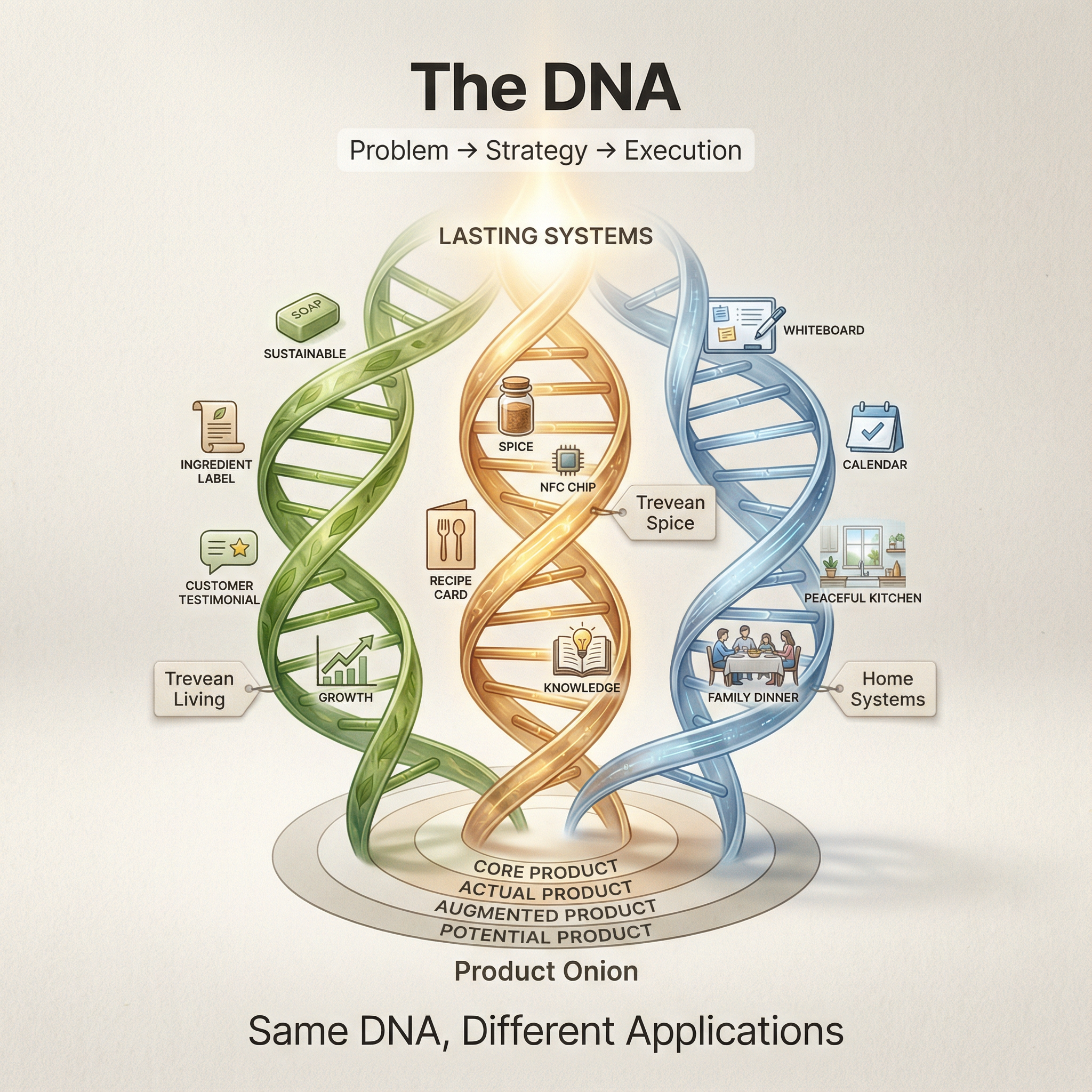
That’s when it hit me: The Product Onion isn’t just some framework I made up for building businesses or getting my life together. It’s more like a pattern language for understanding how anything complex actually works.
And once you see it? You can’t unsee it.
Let me show you what I mean.
The “Wait, This Is All Connected” Moment
Here’s what kept happening across all three systems:
Trevean Living: Customer emails me: “I love your soap. Like, actually love it. But now I want everything in my house to feel like this.”
Trevean Spice: Beta tester tells me: “Okay, I finally get Thai food now. But I want to understand ALL cuisines like this. When’s the next region?”
Home Systems: My wife, three months in: “The dinner thing works really well. Can we… do this for everything else too?”
Same exact pattern: Once you solve the core problem well, people don’t want a different solution. They want MORE of your solution.
That’s not random. That’s a signal.
It tells you that you’ve solved something real, something that fundamentally changes how people relate to a problem, not just temporarily patches it.
But here’s what really got me: The way each system broke BEFORE we fixed it? Also identical.
The Three Ways Things Fall Apart (Every Single Time)
Breaking Point #1: When You Start With The Wrong Problem
Trevean Living (Year 1):
- What we thought the problem was: “People want natural soap”
- Why that sucked: That’s not a problem, that’s just… a preference
- Customer feedback: “Nice products.” (Ouch.)
Trevean Spice (First Attempt):
- What we thought the problem was: “People want higher quality spices”
- Why that sucked: Cool, but so does every other spice company
- Result: Never even got past the idea phase because we had nothing unique
Home Meal System (First Attempt):
- What we thought the problem was: “We need better meal planning”
- Why that sucked: That’s the symptom, not the disease
- Result: Built this elaborate system with three apps and color-coded spreadsheets. Still ordered Thai food four nights a week.
You see it?
When your problem definition is off, everything downstream is built on quicksand. Doesn’t matter how well you execute, how pretty the design is, how clever the marketing—if the foundation’s wrong, it’s gonna collapse eventually.
Here’s the thing:
Most failures aren’t execution failures. They’re “we were solving the wrong problem” failures.
And nobody wants to admit that because it means going back to square one.
Breaking Point #2: When You Skip Strategy and Jump Straight to Cool Stuff
This is the one that almost got me. Multiple times.
Trevean Living (Early Days):
- I designed this gorgeous packaging. Spent weeks on it. It was beautiful.
- Only problem? I hadn’t figured out what made us different from the 47 other “natural soap” brands
- Result: Beautiful products that just… blended into the noise
- The fix: Stopped everything. Defined our actual strategy (performance-first + radical transparency + honest pricing). THEN built features to serve it.
Trevean Spice (Almost Happened):
- I was literally about to start mocking up subscription box designs
- Then I caught myself: “Wait. Are we a spice company or an education platform? Because those are different businesses.”
- The fix: Spent three more weeks on strategy. Education-first + progressive complexity + knowledge-before-product. NOW I know what to build.
Home Meal System (Failed So Hard):
- Downloaded three meal planning apps
- Spent a weekend setting them all up with categories and tags
- Result: Managing the apps became harder than just cooking
- The fix: Threw it all out. Defined the actual strategy (eliminate decisions + match energy states). Then built the simplest possible system to support it.
Here’s what I learned:
Tactics without strategy just creates busy work. You’re moving, but you’re not moving toward anything.
You’re just… moving.
Breaking Point #3: When You Design For Future Perfect
Oh man, this one gets me every time.
Trevean Living:
- At first, we designed for “thoughtful consumers who love researching ingredients and understanding sourcing”
- Reality check: Our actual customers? Overwhelmed parents who want someone they trust to do the research FOR them. They don’t want to become ingredient experts. They want to buy soap.
- The fix: Made ingredient education digestible, not comprehensive. Little hover-over definitions instead of PDF white papers.
Trevean Spice:
- I almost built this “custom blend creator” feature. Seemed cool, right? Like Build-A-Bear but for spices.
- Reality check: People who are just learning about global cuisines don’t have the confidence to create custom blends yet. They need their hand held.
- The fix: Progressive system. Start with pre-made blends, build confidence, THEN unlock single spices and custom blending.
Home Meal System:
- Initial plan: Sunday afternoon, three hours of meal prep, portion everything out
- Reality check: Sunday us is ALSO tired. Adding a three-hour cooking marathon to the weekend made us resent the whole system.
- The fix: Twenty-minute inventory check. That’s it. No marathon prep sessions.
The painful truth:
Your system needs to work for stressed, tired, low-willpower you. Not the motivated version of you who designs the system at 9 AM on a Saturday after two cups of coffee.
The Shared DNA (What Actually Makes Things Work)
Okay, so after seeing these patterns play out across business and life, I found five core principles that show up everywhere. Like, literally everywhere.
DNA Strand #1: Problem Clarity Is a Superpower
Trevean Living’s core problem: “Conscious consumers are forced to choose between products that perform well and products that align with their values”
What that clarity gave us:
- Every product decision became obvious (Does it perform as well as conventional alternatives? No? Then don’t launch it.)
- Marketing wrote itself (Just speak directly to that forced choice)
- Prioritizing features was easy (Does it help solve the choice problem? No? Then it’s not priority.)
Trevean Spice’s core problem: “Home cooks want to explore authentic global cuisines with confidence, but they’re overwhelmed by knowledge gaps and intimidated by ingredient sourcing”
What that clarity gives us:
- Product design is obvious (knowledge + ingredients together, not separate)
- Strategy is clear (education-first, not product-first)
- Features serve the strategy (progressive learning, cultural context, recipe-scaled portions all flow from that)
Home System’s core problem: “Decision fatigue hits at the exact moment when energy is lowest, leading to default behaviors we don’t actually prefer”
What that clarity gave us:
- System design became obvious (eliminate decisions, not meals)
- Everything focused on reducing decision load
- Success metric was clear (Can we go from walking in the door to cooking in under 3 minutes?)
The pattern:
When you have problem clarity, every other decision becomes easier. When you don’t? Every decision is just a guess.
DNA Strand #2: Good Strategy Is Mostly About What You DON’T Do
Strategy isn’t a list of cool things you want to try. It’s a filter.
Trevean Living:
- Turned down a retail partnership that would’ve made our soap $18/bar (violated our “honest pricing” strategy)
- Rejected feedback like “just make it smell nice” (violated our “performance first” strategy)
- Said no to cutting costs by using cheaper ingredients (violated our “radical transparency” strategy)
And let me tell you, saying no to revenue is HARD. But that’s what strategy is.
Trevean Spice:
- Not building the custom blend creator in V1 (violates our “progressive complexity” strategy—people aren’t ready for that yet)
- Not launching in retail first (violates “education-first”—can’t teach in a retail environment)
- Not offering bulk/wholesale (doesn’t serve the core problem at all)
Home System:
- No weeknight recipes over 15 minutes active time (violates “energy-state matching”—I don’t have that energy)
- No meal planning for specific recipes ahead of time (violates “eliminate decisions”—that’s just MORE decisions)
- No guilt-inducing tracking (violates “design for actual self”—I don’t need another thing to feel bad about)
The pattern:
Good strategy is a series of “no” decisions that protect your core approach.
Without strategy? You say yes to everything and stand for nothing.
DNA Strand #3: Features Should Serve Strategy (Not the Other Way Around)
This is where most systems completely fall apart. And I almost did it too.
Trevean Living Example:
Feature that almost happened: Monthly subscription customization (pick your own products each month)
Why it seemed brilliant: Customer choice! Flexibility! That’s what modern DTC brands do!
Why we didn’t build it: Wait. That violates our “eliminate decision fatigue” strategy. Customization means MORE decisions. And our customers literally told us they’re overwhelmed by choices. That’s the whole problem we’re solving.
What we built instead: Pre-curated seasonal boxes based on what people actually use. Zero decisions required.
Result: 82% retention at six months. Turns out “less choice” performed WAY better than “more choice.”
Trevean Spice Example:
Feature that almost happened: “Rate this spice” social feature
Why it seemed smart: User-generated content! Social proof! Engagement metrics!
Why we’re not building it: Hang on. How does rating a spice teach anyone anything? It doesn’t serve our “confidence through knowledge” strategy. It’s just vanity metrics.
What we’re building instead: “Mastery milestones”—you track what you’ve learned to make, share your progression, unlock new regions. That actually teaches something.
Home System Example:
Feature that almost happened: Detailed time-tracking for every meal prep step
Why it seemed useful: Data! Optimization! Know exactly where time goes!
Why I didn’t build it: That adds friction. The whole point is REDUCING friction. I don’t need perfect data. I need dinner on the table without a meltdown.
What I built instead: Simple three-tier energy categorization. Good enough beats perfect.
The pattern:
Every single time you add a feature, ask yourself: “Does this serve our strategy, or am I just adding it because it seems cool?”
If you can’t clearly connect it to strategy, it’s noise.
DNA Strand #4: Transparency Is Weirdly Powerful
This showed up in ways I totally didn’t expect.
Trevean Living:
Our “Behind the Price” breakdown—where we literally show you where every dollar of your purchase goes—became our most-shared piece of content. Not because it was clever marketing. Because it was just… honest.
People are so tired of being sold to. They’re starved for honesty.
And our ingredient glossaries? People spend an average of 4+ minutes reading them. FOUR MINUTES. On ingredient explanations. Because we’re teaching, not spinning marketing BS.
Trevean Spice:
The NFC transparency tech (tap your phone, see the exact farm) isn’t a gimmick. It’s proof.
In a world where “authentic” and “ethically sourced” have become meaningless marketing buzzwords, being able to show the actual farm, the actual harvest date, the actual supply chain—that’s real differentiation.
You can’t fake that.
Home System:
Writing down the “why” behind our meal system and sharing it with my wife changed everything.
It went from “Dan’s weird arbitrary rules that I have to follow” to “oh, this is our shared strategy that I can modify because I understand the principles.”
Huge difference.
The pattern:
Transparency isn’t a nice-to-have add-on. It’s a strategic advantage.
People trust systems they understand.
DNA Strand #5: Good Enough Now Beats Perfect Later
None of these systems launched perfectly. They all got better by actually using them.
Trevean Living:
- V1 website bounce rate: 73% (yikes)
- V2 with clearer copy and category labels: 41% (better!)
- V3 with ingredient hover-overs: 35% (even better!)
Each version taught us something. If we’d waited for “perfect,” we’d still be designing.
Trevean Spice:
- Still in beta, still learning
- Customer interview #12 completely changed our pricing strategy
- Customer interview #31 revealed a feature we almost missed (substitution guides)
You literally cannot design the perfect system sitting at your desk. You have to test it against reality.
Home System:
- First decision board: 15 options per category (way too overwhelming)
- Second iteration: 5 options (better)
- Third iteration: 4 options, rotated monthly (just right)
Each iteration stripped out complexity. Perfect wasn’t the goal. Effortless was.
The pattern:
Ship the simplest version that solves the core problem. Learn from real use. Iterate. Repeat.
Perfect is the enemy of learning.
The Framework You Can Use (For Literally Anything)
Okay, so after seeing these patterns across business and life, I’ve boiled the Product Onion down to six simple questions you can ask about anything:
The 6-Question Audit
Question 1: Can you state the core problem in one sentence?
If you can’t, you don’t understand it yet. Keep digging. This is the most important one.
Question 2: Does your strategy have clear “no” statements?
Like: “We don’t do X because it violates Y principle.”
If you can’t articulate what you WON’T do, you don’t have strategy. You just have intentions and hopes.
Question 3: Can you trace every feature back to the strategy?
Seriously, try it. Draw a line from each feature to the strategic pillar it serves. If you can’t draw the line, it’s noise.
Question 4: Would your system work for you on your worst day?
Not your best day. Not the day you designed it when you were motivated and caffeinated. Your actual worst day—tired, stressed, everything going wrong.
If not, redesign it.
Question 5: Is it transparent why you made these choices?
Could someone else understand the reasoning? Or does it only make sense in your head?
Question 6: Are you iterating based on real use or theoretical optimization?
Data from reality beats opinions from planning sessions. Every time.
Try This Right Now
Pick something you’re building—a business, a product, a life system, a team process, whatever.
Step 1: Write down the problem you’re solving
Not what you’re building. What problem you’re solving. Be specific.
Step 2: Reality-check if it’s the real problem
- Is it specific enough that you could measure whether you solved it?
- Is it creating friction in people’s lives right now?
- Is it a root cause or just a symptom?
Step 3: Define your strategy as “no” statements
- We won’t _____ because _____
- We won’t _____ because _____
- We won’t _____ because _____
Step 4: Map your current features to your strategy
- Which features actually serve the strategy?
- Which features are just noise you added because they seemed cool?
- What’s missing?
Step 5: Simplify for worst-case user
- Remove anything that requires high willpower, energy, or motivation
- Make it work for tired, stressed, end-of-day reality
Step 6: Ship, learn, iterate
- Launch the simplest version that could possibly work
- Collect real data from real people
- Adjust based on reality, not theory
That’s it. That’s the whole framework.
The Big Universal Truth (What This All Actually Means)
Alright, after building three totally different systems—one physical product business, one service-product hybrid, one personal life thing—here’s what I know for sure:
The Product Onion isn’t actually about products.
It’s about understanding how complex systems work. Any complex system.
Whether you’re building:
- A business
- A product
- A life system
- A team process
- A community
- A movement
- Whatever
The same principles apply every single time:
- Get the problem definition right (everything flows from this)
- Define your strategy as constraints (what you WON’T do matters more than what you will)
- Build features that serve strategy (resist the urge to add cool stuff that doesn’t)
- Design for reality, not aspiration (worst-case user, not best-case)
- Make it transparent (people trust what they understand)
- Iterate based on actual use (reality always beats theory)
Start from the inside and work your way out.
Problem → Strategy → Features → UX → Communication → Execution
That’s the order. Every time. No shortcuts.
What’s Next (The Bigger Picture Stuff)
Here’s what I’m seeing as I look at where all this is going:
The businesses and systems that are gonna win in the next decade? They’re not gonna be the ones with the most features, the biggest marketing budgets, or the slickest design.
They’re gonna be the ones with the clearest problem definition and the most disciplined strategy.
Because in a world of infinite options, clarity is the competitive advantage.
For Trevean Living: We’re expanding beyond soap and candles into a full “transparent living” ecosystem. Same core problem (that forced choice between values and performance), just bigger application.
For Trevean Spice: If we nail the education-first model and the transparency tech, we’re not really building a spice company. We’re building infrastructure for food transparency that could work for any specialty food category. That’s the bigger play.
For Home Systems: I’m documenting all of this and maybe—maybe—building some kind of framework or community for people who want to apply this thinking to their lives, not just their businesses.
The common thread: All three start narrow and specific, but the systems we’re building? They’re designed to scale wide.
That’s the opportunity I’m chasing.
Start with a specific, painful problem. Build a system that solves it better than anyone else. Then realize the system you built actually works for adjacent problems too.
That’s how you build something that lasts. That’s how movements start.
Your Turn (The Final Challenge)
So look, I’ve shown you:
- How we rebuilt Trevean Living from the inside out (went from $47K to $410K)
- How we’re building Trevean Spice using this from day zero
- How I applied the same thinking to my personal life
- The patterns that connect all three
- The framework to apply this to literally anything
Now it’s your turn.
Pick one thing—a business, a product, a life system, doesn’t matter—and audit it:
- What problem are you actually solving? (Be brutally honest with yourself)
- Do you have a clear strategy, or just a bunch of tactics you’re trying?
- Are your features serving the strategy, or are you building noise?
- Would your system work for you on your worst day?
- Is it transparent why you made these choices?
- Are you iterating based on real use, or just theorizing?
If you can’t answer these clearly, you’re probably building from the outside in.
And eventually—trust me on this—that catches up with you.
Thank you for sticking with this series. If you actually read all five parts, you’re in a pretty small group of people who do the work of understanding instead of just consuming content and moving on.
That matters. That means something.
Now go build something that lasts.