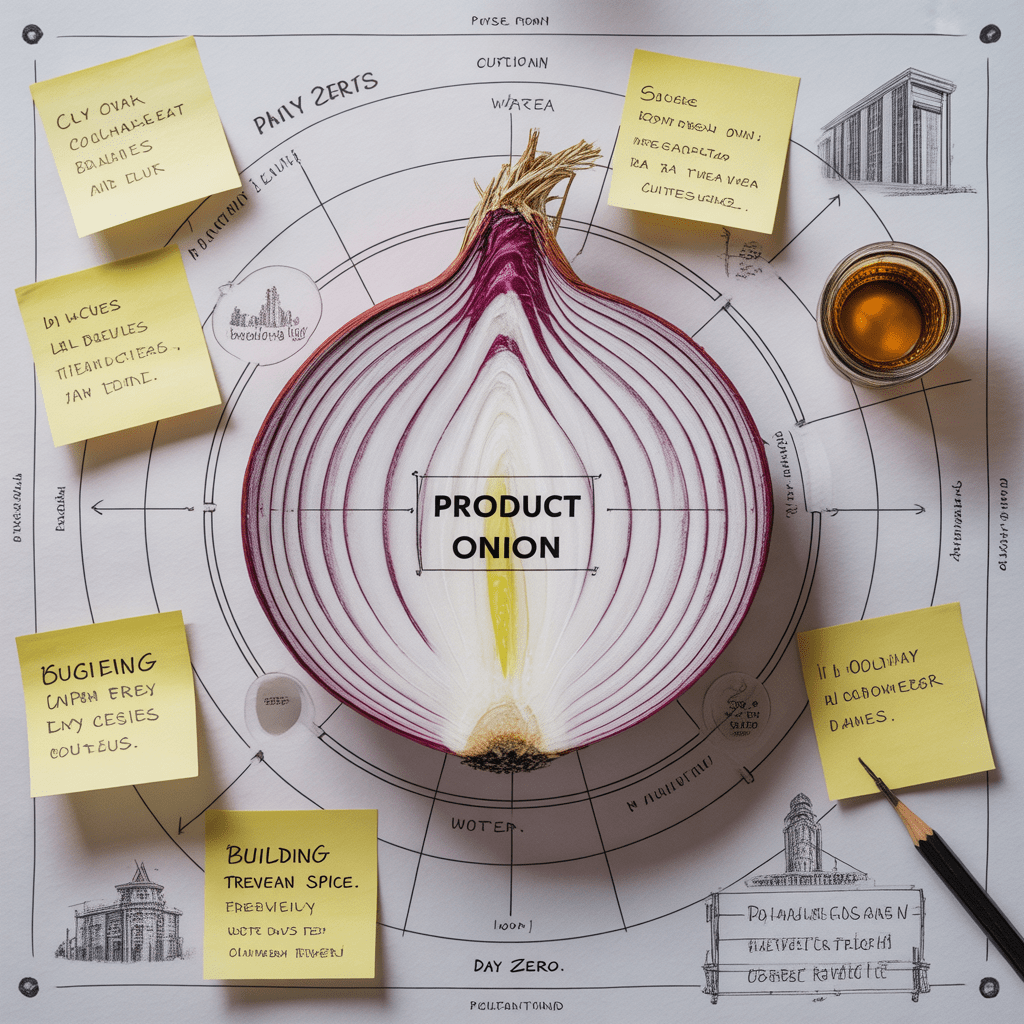
Part 3 of the Product Onion Series
I still don’t have a logo for Trevean Spice.
And it’s driving some people crazy.
Last week, a well-meaning friend asked: “So when are you launching? I could help you design a website!” Another said: “Have you thought about your Instagram strategy? You need to build buzz early!”
Here’s what I told them: I’m not ready for any of that yet.
Not because I’m procrastinating. Not because I’m overthinking it. But because I’m still on Layer 1 of the Product Onion, and I refuse to make the same mistakes I made with Trevean Living.
This time, I’m documenting the entire process—from the first question to the final launch. You’re going to see the Product Onion framework in action from day zero, including all the messy, uncertain, “I have no idea if this will work” moments that nobody usually talks about.
So buckle up. This is what building from the inside out actually looks like when you’re staring at a blank page.
Layer 1: Finding the Core Problem (The Part That Takes Longer Than You Think)
Most people think the first question is: “What product should I make?”
Wrong.
The first question is: “What problem actually exists in the world that’s creating friction in people’s lives?”
The Wrong Problem (Take 1)
My first instinct: “People want better quality spices than what they get at the grocery store.”
Okay, but… do they? Or is that just what I want as a home cook?
I started digging. Talked to 47 people over three weeks. Home cooks, restaurant chefs, food bloggers, people who barely cook at all.
The Wrong Problem (Take 2)
Second attempt: “Home cooks waste money buying full jars of specialty spices for single recipes.”
Warmer. That’s definitely a pain point. But when I kept probing, I realized this was a symptom, not the core problem.
Finding the Real Problem (The Conversation That Changed Everything)
I was talking to Lisa, a 32-year-old marketing manager who loves cooking. She said something that stopped me cold:
“I want to make authentic Thai curry, but I have no idea what’s actually in it. So I Google ‘Thai curry paste,’ and I get seventeen different recipes with different ingredients. Then I go to the store, and the jarred paste has ingredients I can’t pronounce. So I end up buying individual spices—galangal, lemongrass, kaffir lime—and half of them I can’t even find. When I do find them, they’re $8 each for giant containers. I use a tablespoon and the rest sits in my cabinet for two years. Eventually, I just… order Thai food. It’s easier.”
She wasn’t asking for better spices. She was asking for confidence.
I heard this pattern over and over:
- “I don’t know what ‘authentic’ actually means anymore”
- “I can’t tell if spices are fresh just by looking at them”
- “I want to explore global cuisines, but I don’t know where to start”
- “I feel stupid asking basic questions at specialty spice shops”
The Deeper Pattern (Why This Matters Now)
Here’s what I noticed: This problem is getting worse, not better.
My generation grew up with globalized food culture. We’ve traveled, we’ve eaten at authentic restaurants, we follow chefs on social media. We know what good Thai curry tastes like. We know what real Moroccan tagine should smell like.
But we don’t know how to recreate it.
Meanwhile, we’re also the generation rejecting processed food and demanding transparency. We read ingredient labels. We care about sourcing. We want to know where our food comes from.
And here’s the kicker: We’re drinking less wine and spending that money on… food experiences.
I looked at the data. Wine consumption among millennials and Gen Z is down 20% in the last decade. But spending on “specialty food” and “international ingredients” is up 34%. People are redirecting their experiential spending from wine culture to food culture.
That’s not just a trend. That’s a generational shift.
The Core Problem (Finally)
Home cooks want to explore authentic global cuisines with confidence, but they’re overwhelmed by lack of knowledge, intimidated by specialty ingredient sourcing, and frustrated by waste and uncertainty—all while craving the same kind of cultural storytelling and transparency they’re getting from craft coffee and artisanal chocolate.
That’s a mouthful. But that’s the problem.
Not “people want better spices.” People want confidence, knowledge, and connection to the food they’re making.
Layer 2: Domain Logic & Strategy (How We’ll Solve It Differently)
Once I had the real problem, I could map out the strategic approach.
Here’s where most spice companies go:
- Compete on quality and freshness
- Offer subscriptions or monthly boxes
- Tell origin stories about farmers
- Use beautiful packaging
Those are fine. But they’re all tactics, not strategy.
Our Strategic Pillars (The Stuff That Makes Us Different)
Pillar 1: Knowledge Before Product We’re not selling spices. We’re teaching a curriculum. The spices are the textbooks.
Every spice or blend comes with:
- Cultural context (why this matters in that cuisine)
- Sensory education (what you should smell, taste, see)
- Usage guidance (when to add it, how much, what it does)
- Quality markers (how to tell if it’s fresh, what to look for)
Pillar 2: Small-Batch, Recipe-Scaled Portions No more $12 jars of cardamom for one recipe. You get what you need, in the amount you’ll actually use, at peak freshness.
But here’s the twist: It’s not random. It’s curated around culinary regions and techniques.
Pillar 3: Transparent Traceability Every package has NFC technology (tap with your phone). You see:
- Exact origin (not just “Vietnam” but the specific farm/region)
- Harvest date
- Processing method
- Freshness timeline
- Full supply chain
This isn’t marketing fluff. This is data. Because transparency builds confidence.
Pillar 4: Progressive Complexity Start with approachable blends (Moroccan tagine spice, Thai curry base). Build confidence. Then introduce single-origin specialty ingredients.
You don’t hand someone calculus before algebra. Same principle.
The Strategic Pivot Potential (The Long Game)
Here’s what’s really interesting: If we build this right, Trevean Spice isn’t just a spice company.
It’s a food transparency technology platform that happens to start with spices.
The NFC system? That can work for any packaged food. The traceability infrastructure? That’s valuable to any brand wanting to prove sourcing claims. The education model? That’s a framework for any specialty food category.
We’re building a business that could start by competing in the spice market, but pivot to becoming a technology enabler for food transparency across industries.
Start narrow. Build systems that scale wide.
(But I’m getting ahead of myself. That’s Year 3 thinking. Right now, I need to prove Layer 1 works.)
Layer 3: Features & Functionality (What This Actually Looks Like)
Now—and only now—do I start thinking about specific features.
Product Features (The Non-Negotiables)
Feature Set 1: The Physical Product
- Small-format packaging (2-4 servings worth)
- Regional “kits” curated by cuisine
- Freshness dating (packed date + “best by” date)
- Airtight, light-blocking packaging
- Reusable containers (because sustainability matters to this customer)
Feature Set 2: The Knowledge Layer
- Recipe cards paired with each spice/blend
- QR codes linking to video tutorials
- “Spice Passport” system (track what you’ve tried, what you’ve mastered)
- Glossary of terms (what the hell is “tempering” anyway?)
- Substitution guides (don’t have X? Use Y instead)
Feature Set 3: The Technology Layer
- NFC chips embedded in packaging
- Mobile app that reads the chip and shows full traceability
- Freshness tracker (notifies when spices are getting old)
- Automatic reorder suggestions based on usage
- Community recipe submissions
Feature Set 4: The Experience Layer
- Flavor profile quiz (before you buy anything)
- “Start Here” beginner kits
- Progressive pathway (beginner → intermediate → advanced)
- Virtual tasting sessions (monthly live events)
- Direct access to spice experts (not chatbots—real people)
The Features We’re NOT Building (Yet)
This is just as important. Here’s what I’m intentionally leaving out of V1:
❌ Custom blend creator (too complex for new users)
❌ International shipping (need to prove domestic first)
❌ Retail partnerships (want to control the customer experience initially)
❌ Bulk/wholesale options (doesn’t serve the core problem)
Why? Because every feature needs to serve the core problem. If it doesn’t reduce overwhelm, build confidence, or create connection, it’s noise.
Layer 4: User Experience & Interface (Making Confidence Feel Effortless)
This is where I’m spending the most time right now. Because if the UX doesn’t reduce friction, we’ve failed—regardless of how good the spices are.
The Customer Journey (Mapped to Reduce Anxiety)
Step 1: Discovery (No Assumptions)
- Quick quiz: “What’s your cooking confidence level?” (Not “what’s your favorite cuisine?”)
- Results show a recommended starting point
- Clear next steps (no wandering through 50 products)
Step 2: First Purchase (Making It Safe)
- “Starter Kit” options by region (Thai Essentials, Mediterranean Basics, etc.)
- Clear expectations: “This kit makes 3 authentic dishes”
- Small commitment: $28-35 range (not $100 subscription)
- Money-back guarantee (if you don’t feel more confident, we refund)
Step 3: Unboxing (Education Begins Immediately)
- Clear numbered guide: “Start with this”
- Visual infographic: “Here’s what each spice does”
- Recipe card with photos of each step
- QR code: “Watch the 3-minute video”
Step 4: Cooking (Support in Real-Time)
- Spice Passport tracks what you’ve used
- App notifications: “You’re halfway through your cumin—want to reorder?”
- Community feature: “Share your dish or ask questions”
Step 5: Mastery (Progressive Complexity)
- After 3 successful dishes: “Ready for intermediate?”
- Unlock new regions and techniques
- Earn “certifications” (gamification that actually teaches)
The UX Mistake I’m Avoiding
I talked to a competitor’s customer who said: “I bought their subscription, and every month I got random spices I didn’t know how to use. I felt guilty not using them, so I cancelled.”
That’s a UX failure masked as a product failure. The product was fine. The experience created anxiety instead of confidence.
Our UX principle: Never send someone a spice without giving them the knowledge to use it successfully.
Layer 5: Product Marketing & Messaging (The Story We Tell)
Okay, NOW we get to talk about marketing. But notice: I’m not guessing at messaging. I’m translating the problem we solve into language our customers already use.
Messaging Framework
Instead of: “Premium small-batch spices from around the world”
We say: “Finally understand what makes Thai curry actually taste Thai—without wasting $60 on ingredients you’ll use once”
Instead of: “Ethically sourced, traceable ingredients”
We say: “Tap your phone. See the farm. Know your food.”
Instead of: “Monthly spice subscription”
We say: “Your culinary passport to authentic global flavors—one region at a time”
Content Strategy (Education-First Marketing)
Content Pillars:
- Spice Education Series
- “What You’re Actually Tasting When You Taste Cumin”
- “Why Your Curry Doesn’t Taste Like the Restaurant’s (It’s Not Your Fault)”
- “The 5 Spices That Unlock 80% of Global Cuisines”
- Transparency Stories
- Video series: Farm to Kitchen (follow a spice from harvest to your home)
- “Behind the Blend” breakdowns
- “Ask a Spice Expert” live Q&As
- Customer Success Stories
- Before/After: “I Used to Order Thai Food. Now I Make It Better.”
- “My Moroccan Tagine Made My Mother-in-Law Cry (In a Good Way)”
- Time-lapse videos of customers’ progression
- Cultural Context
- “The History of Garam Masala (And Why It Matters)”
- Chef interviews from different cultures
- “This Is What Authentic Tastes Like” series
The Campaign That Launches Us
“The 30-Day Global Kitchen Challenge”
Join 500 home cooks learning authentic dishes from 5 different cuisines in 30 days.
Week 1: Thai Week 2: Moroccan
Week 3: Indian Week 4: Mexican
Daily emails with tips, live cooking sessions, community sharing, and progressive skill-building.
Cost: $99 (includes all spices for 12 dishes + digital cookbook + access to expert coaching)
This isn’t a sale. It’s proof of concept. It’s 500 people we’ll learn from before we scale.
Layer 6: Sales & Go-to-Market Strategy (How We Actually Launch)
Most founders want to launch big. I’m doing the opposite.
Phase 1: Private Beta (Months 1-3)
- 200 hand-selected customers (friends, family, food bloggers, home cook communities)
- Heavy feedback collection (weekly surveys, monthly interviews)
- Iterate on everything: packaging, recipes, portions, pricing
- Goal: 70%+ saying “I’d recommend this to a friend”
Phase 2: Limited Launch (Months 4-6)
- Open to 500 customers (waitlist from beta interest)
- “30-Day Global Kitchen Challenge” as primary onboarding
- Focused on retention metrics, not growth
- Goal: 60%+ reorder rate within first 60 days
Phase 3: Public Launch (Months 7-12)
- Direct-to-consumer website goes fully public
- Content marketing ramps up (SEO, social, partnerships)
- Referral program launches (“Give Confidence, Get Confidence”)
- Strategic partnerships with cooking education platforms
Distribution Channels (Prioritized)
Primary: Direct-to-consumer (own the customer relationship)
Secondary: Strategic retail (only partners who understand the education component—think Williams Sonoma, not Whole Foods… yet)
Tertiary: Corporate gifting (companies wanting to give experiential, culturally rich gifts)
Pricing Strategy (Honest Math)
This is where I’m being really careful. The core problem includes “frustrated by waste.” So our pricing has to feel fair.
Starter Kits: $28-35 (3-4 spices, makes 3 dishes)
- Our cost: $14 (ingredients, packaging, shipping)
- Margin: 50% (reinvest in education content and customer support)
Monthly “Passport” Subscription: $42/month
- One region per month
- 4-5 spices/blends
- 5 recipes
- Access to live monthly cooking session
Individual Spices: $8-12 (small format)
- Higher margin, but positioned as “building your library” after you’ve found confidence
Enterprise/B2B (The Long Game):
- License our NFC transparency platform to other food brands
- Revenue model: $2K-10K/month depending on volume
- This is Year 2-3 thinking, but the infrastructure we’re building supports it
The Metrics We’ll Track (Before We Launch)
Here’s what I care about in beta:
Confidence Metrics:
- % who say “I feel more confident cooking [cuisine]” post-purchase
- % who successfully complete recipes on first try
- % who attempt a recipe without watching the video (sign of retained knowledge)
Engagement Metrics:
- Time spent with educational content
- NFC chip taps (are people actually using the transparency feature?)
- Recipe completion rate
- Community participation (recipe shares, questions asked)
Business Metrics:
- Cost per acquisition (goal: under $40)
- Repeat purchase rate (goal: 60%+ in first 60 days)
- Customer lifetime value (goal: $350+)
- Net Promoter Score (goal: 70+)
- Sample-to-subscription conversion (goal: 50%+)
The Metric That Matters Most: “On a scale of 1-10, how much has this changed your relationship with cooking?”
If we’re not getting 8s, 9s, and 10s, we haven’t solved the core problem.
What I’m Learning (In Real-Time)
Learning #1: The Problem Is Bigger Than I Thought
I thought this was about spices. It’s actually about cultural confidence. About feeling capable of recreating experiences. About not feeling stupid in your own kitchen.
That’s a much bigger, much more valuable problem to solve.
Learning #2: The Competition Isn’t Other Spice Companies
My real competition is DoorDash and UberEats. I’m competing with the ease of ordering restaurant food.
So I need to make cooking feel easier, more rewarding, and more connected than ordering takeout.
Learning #3: Technology Is a Tool, Not a Feature
The NFC chips aren’t a “cool feature.” They’re a confidence-building tool. When someone can tap their phone and see the exact farm their cumin came from, it transforms the relationship with the product.
That’s not novelty. That’s solving the trust problem.
Learning #4: I’m Building a Learning Platform That Happens to Sell Spices
The real value isn’t in the jars. It’s in the knowledge transfer. It’s in someone going from “I don’t know what I’m doing” to “I just made authentic pad Thai and my family couldn’t believe it.”
The spices are the medium. Confidence is the product.
What I Don’t Know Yet (The Honest Part)
Let me be clear: This could completely fail.
Here’s what keeps me up at night:
Unknown #1: Will people actually pay $35-42/month for this? Or will they try it once and go back to buying $4 jars at Kroger?
Unknown #2: Can we make the education engaging enough that it doesn’t feel like homework?
Unknown #3: Is the NFC technology overkill? Or will it be the thing that differentiates us?
Unknown #4: Will the “start narrow, scale wide” strategy actually work? Or will we be stuck as a niche spice company?
Unknown #5: How do we balance “authentic” with “accessible”? If we dumb things down too much, we lose the cultural respect. If we’re too purist, we intimidate people.
I don’t have answers yet. That’s what beta is for.
The Big Strategic Bet (Why This Could Be Bigger Than Spices)
Here’s the thing I keep coming back to: If we build the transparency infrastructure right, if we create a model for education-first product commerce, if we prove that you can compete on trust and knowledge instead of just price and convenience…
We’ve built something that works for any specialty food category.
Wine. Olive oil. Chocolate. Coffee. Cheese. Tea.
Any product where:
- Quality is hard to assess
- Knowledge creates confidence
- Transparency builds trust
- Cultural context adds value
We start with spices because the problem is acute, the market is underserved, and the unit economics work.
But the model? That could reshape how people buy specialty food entirely.
That’s the vision. But visions don’t build businesses. Solving real problems for real people builds businesses.
So right now, I’m focused on Layer 1. Making sure we’ve got the core problem right. Making sure our strategy actually solves it. Making sure every feature, every piece of UX, every word of marketing serves that one goal:
Give home cooks the confidence to explore global cuisines without the overwhelm, waste, and uncertainty.
Everything else is just implementation.
What’s Next
In the next post, I’m going to show you something completely different: how the Product Onion framework applies to personal systems, not just businesses.
We’re going to talk about “Home Project Systems”—the methodology I use to manage everything from meal planning to home renovations using the exact same inside-out thinking.
Because here’s the secret: The Product Onion isn’t just for products. It’s a way of thinking about any complex system.
And your life? That’s the most complex system of all.
Your turn: If you were building a food business from scratch today, what core problem would you solve? Drop a comment—I’m genuinely curious what problems you see that aren’t being solved.
Next in series: The Product Onion at Home: How Inside-Out Thinking Changed How I Manage Life, Not Just Business

 The Product Manager's Journal
Leave a comment