Let me tell you about the moment I realized I was building my business completely backwards.
I was sitting at my kitchen table, surrounded by product samples, market research, and a beautiful brand guide. I had spent weeks perfecting the logo for what would eventually become Trevean Living. The colors were perfect. The packaging looked Instagram-ready. I had mockups of how our soaps would look on retail shelves.
There was just one problem: I hadn’t actually figured out why anyone needed another soap company.
Sound familiar?
What Is the Product Onion (And Why Should You Care)?
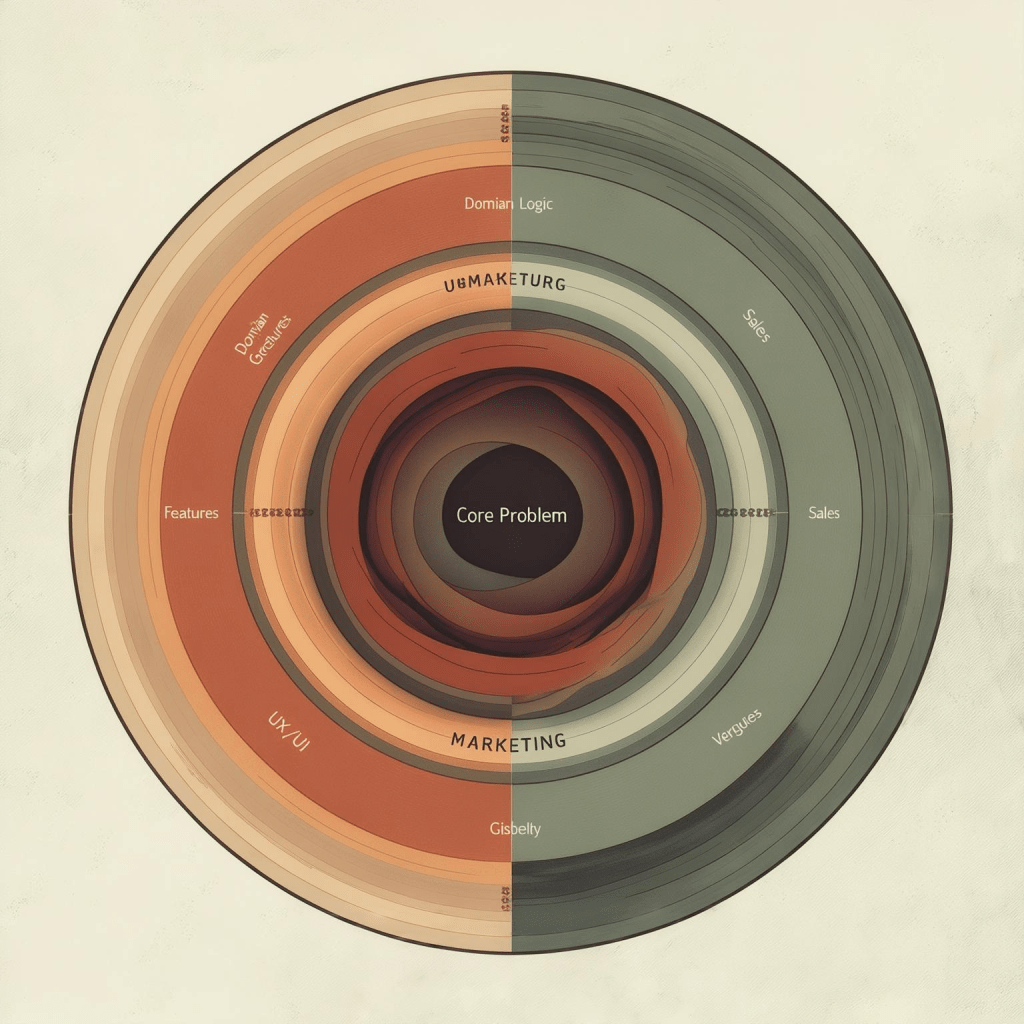
The Product Onion is a framework that forces you to build your business from the inside out—starting with the problem you’re solving and working your way outward to the pretty stuff. Think of it like an actual onion: each layer depends on and protects what’s beneath it.
Most entrepreneurs (myself included) want to jump straight to the exciting outer layers—the branding, the website, the launch campaign. But here’s the thing: if your core is rotten, no amount of beautiful packaging will save you.
The framework has six layers, and they build on each other in this order:
Layer 1: The Core Problem (The Heart of the Onion)
This is where everything begins. What problem are you actually solving? Not “what product are you selling,” but what specific pain point keeps your customer up at night?
Bad example: “We sell organic spices.”
Good example: “Home cooks are tired of buying expensive jars of specialty spices for one recipe, then watching them sit in the cabinet for two years until they lose all flavor and get thrown away. They want to explore global cuisines without the waste and expense.”
See the difference? One is about you. The other is about your customer’s actual problem.
For Trevean Living, the core problem wasn’t “people need soap.” It was “conscious consumers want products that don’t force them to choose between what’s good for their skin and what’s good for the planet—and they’re tired of eco-friendly products that perform poorly or cost a fortune.”
Layer 2: Domain Logic & Product Strategy
Once you know the problem, this layer is about how you’ll uniquely solve it. This is your secret sauce—the approach that makes your solution different from the seventeen other people solving the same problem.
Using the spice example: Your domain logic might be a subscription model with small-batch quantities matched to specific recipes, plus a freshness tracking system. Someone else might solve the same problem with a spice-of-the-month club. Another person might create a spice library service where you “rent” exotic spices.
All solving the same core problem. Completely different approaches.
Layer 3: Features & Functionality
Now—and only now—do you start thinking about specific features. These should flow naturally from your domain logic.
If your domain logic is “small-batch, recipe-matched subscriptions,” your features might include:
- Customizable spice selections based on cooking preferences
- Recipe cards paired with each shipment
- QR codes linking to video tutorials
- Freshness date tracking
- Automatic reorder suggestions
Notice how each feature directly supports the strategy? That’s the point. Features without strategy are just noise.
Layer 4: User Experience & Interface
This is where design comes in—but it’s informed by everything beneath it. Your UX should make it effortless for customers to solve that core problem.
For a spice subscription, this might mean:
- A 2-minute quiz that actually understands cooking skill level and flavor preferences
- Clear visual indicators of freshness
- One-click reordering
- A clean, uncluttered interface that doesn’t overwhelm new cooks
The design serves the function, which serves the strategy, which solves the problem.
Layer 5: Product Marketing & Messaging
Now you’re getting to the stuff that lives on your website and social media. But here’s the magic: if you’ve built the inner layers correctly, your marketing practically writes itself.
You’re not guessing about messaging. You’re not testing fifteen different value propositions. You know exactly what problem you solve and for whom, so you can speak directly to that.
Instead of: “Premium artisanal spices delivered to your door”
You say: “Stop throwing away $200 worth of stale spices every year. Get exactly what you need, when you need it, at peak freshness.”
Layer 6: Sales & Go-to-Market Strategy
The outermost layer is how you actually get your product in front of people and convert them to customers. This includes your pricing strategy, sales channels, partnerships, and growth tactics.
But notice: you’re not figuring out how to sell until you know everything else. Because how you sell depends on who you’re selling to, what problem you’re solving, and how you’ve designed the experience.
Why This Order Matters (A Cautionary Tale)
Here’s what happens when you build from the outside in:
You create a gorgeous Instagram presence. You get 10,000 followers. You launch with a big splash. People buy once because your branding is beautiful and they want to support you.
And then they don’t come back.
Because underneath the pretty exterior, you haven’t actually solved a problem they care enough about to change their behavior for. Your features don’t quite make sense together. Your user experience has friction points. Your messaging attracted the wrong audience.
I’ve watched this happen to dozens of businesses (and nearly did it myself). They spend months perfecting the outer layers and skip the hard work of getting the core right.
The Uncomfortable Truth
Building with the Product Onion framework takes longer upfront. It’s less exciting. You can’t post progress photos of market research on Instagram. There’s no dopamine hit from picking brand colors when you’re still validating whether your core problem is real.
But here’s what you get instead: a business that actually works. Where every layer reinforces the others. Where your marketing resonates because it’s rooted in real problems. Where features make sense because they serve a clear strategy. Where customers stick around because you’re genuinely solving something they care about.
How to Use This Framework
Over the next few posts, I’m going to walk you through how I’ve applied the Product Onion to three different ventures:
- Trevean Living – How an eco-friendly lifestyle brand found its core by getting honest about what “sustainability” really means to our customers
- Trevean Spice – Building a new spice business from scratch using this framework (and why I’m not designing the logo yet)
- Home Project Systems – How the same principles apply to organizing your life, not just building a business
For each one, I’ll show you the actual work that happens at each layer, the metrics we track, and the mistakes we made (because trust me, there were plenty).
But first, I want you to try something: pick a project you’re working on—a business, a product, even a major life goal—and draw your own onion.
Start from the inside and ask: What’s the core problem? Not what you want to build or sell. What problem are you solving?
If you can’t answer that clearly, you’re not ready for the outer layers yet.
And that’s okay. That’s exactly where the best businesses begin—with a question, not an answer.
Next up: How Trevean Living went from “pretty soaps” to a purpose-driven brand by getting the core layer right (and what we had to un-learn along the way).
Want to build your own Product Onion? Drop a comment below with your project, and I’ll help you identify your core layer.

 The Product Manager's Journal
Leave a comment