You know what’s funny? For all the talk about “strategy” in business, it’s amazing how many companies don’t actually have one. Or at least, not one that anyone can explain or understand. I’ve been thinking about this a lot lately.
Let me ask you something: If you grabbed five random people from your company and asked them to explain your organization’s strategy, would they all give the same answer? Or even similar answers? In my experience, the answer is usually a resounding “nope.”
See, a well-crafted strategy is like a perfectly balanced recipe – it brings harmony to disparate elements, creates a unified experience, and transforms the ordinary into something remarkable. Throughout my career, I’ve seen how the presence or absence of clear strategy can absolutely make or break an organization’s future.

When Strategy Goes Missing: A Cautionary Tale
Let me tell you about a company I once worked for (maybe it’ll sound familiar to some of you). We went through a major leadership change, and what followed was… well, nothing. Eight months of strategic limbo – a period where company and product strategy simply vanished into thin air.
You know what it was like? The executives would disappear into their conference rooms and emerge occasionally to announce random tactical decisions. “We created an 80-page vision document!” “We’re pivoting to a new customer segment!” But there was never any explanation of WHY we were doing these things or how they fit into a larger plan.
The effect on the team was devastating. I watched as my colleagues, once passionate and motivated, became increasingly demoralized. Productivity tanked. People started having these existential conversations by the coffee machine: “What are we even doing here?” Not good.
Then came the fateful day when they eliminated multiple divisions to “save money” – a purely tactical response that did nothing to address the underlying strategic vacuum. It was like a chef randomly removing ingredients from a dish without understanding how each contributes to the flavor. “This sauce has too many ingredients. Let’s remove… I don’t know… the salt and the main protein. That should cut costs!”

I contrast this with organizations I’ve seen that actually invest in thoughtful strategy development. The difference is night and day. By implementing a systematic process for crafting and communicating strategy, these companies transform confusion into clarity, disengagement into purpose, and stagnation into growth. And it’s not magic – it’s just good process.
The Strategy Blocks Framework
So how do we fix this? Well, I recently came across Chandra Janakiraman’s Strategy Blocks framework in Lenny’s Newsletter, and it blew my mind with its simplicity and effectiveness. I’ve now seen it transform organizations by providing a systematic approach that bridges the gap between those lofty vision statements (“We’re going to revolutionize XYZ industry!”) and the actual day-to-day work that people do.
Here’s what’s cool about the Strategy Blocks approach: it recognizes that we need to think about strategy on two different time horizons simultaneously:
- Small “s” strategy: This is your practical 2-year strategy focused on solving immediate problems with your current product or business. It’s the “roll up your sleeves and fix what’s broken” part.
- Big “S” strategy: This is your visionary 3/5/10-year strategy focused on aspirational futures that align with your company’s mission. It’s the “where are we ultimately headed” part.
Think of it like planning a road trip. The small “s” strategy addresses immediate concerns like fixing the flat tire and finding the next gas station. The big “S” strategy is about deciding whether you’re ultimately headed to the Grand Canyon or Niagara Falls. You need both!
Let me walk you through how any organization can implement this framework. I promise it’s not as complicated as it might sound.
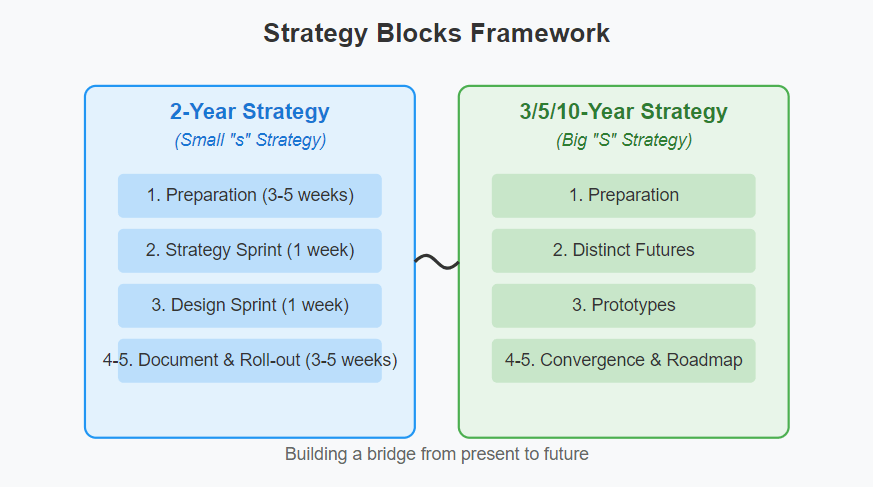
Part 1: Developing Your 2-Year Strategy (Small “s” Strategy)
Step 1: Preparation (3-5 Weeks)
First things first – you need to get the right people in the room. I can’t stress this enough. Strategy isn’t something the CEO should cook up alone on a weekend retreat. It requires diverse perspectives.
Start by assembling a strategy working group that includes:
- Product leadership (because they understand what you’re building)
- Engineering representation (because they know what’s feasible)
- Design expertise (because they understand the user experience)
- Data/analytics capabilities (because numbers don’t lie)
- Other relevant domain experts (because context matters)
Now, here’s where most companies go wrong: they jump straight to solutions. “We need a mobile app!” “We need to expand to Europe!” Whoa, slow down. Instead, assign each member of your working group specific research tasks:
Behavioral Insights: Have your data folks compile findings from customer usage patterns, retention data, and other relevant metrics. What are people actually doing with your product? Where are they getting stuck? Where are they finding value?
User Research: Get your researchers to synthesize qualitative feedback from customer interviews and focus groups. What are people saying about your product? What frustrations do they express? What delights them?
Leadership Interviews: This one’s crucial and often overlooked. Conduct one-on-one sessions with executives and founders, asking questions like:
- “What does success look like for our organization?” (You’d be surprised how often leaders have different answers!)
- “What principles should guide our product development?”
- “Why do you think past initiatives failed to gain traction?”
I once worked at a company where the CEO had a completely different vision than the rest of the executive team. We only discovered this through these interviews. Imagine if we had built a strategy without knowing that!
Competitive Analysis: Create a detailed comparison of competitors and adjacent players. What are they good at? Where do they struggle? What appears to be their focus? This isn’t about copying competitors – it’s about understanding the landscape.
User Observations: Have every team member observe actual customers using your products. There’s nothing like watching someone struggle with your “intuitive” interface to ground your strategic thinking in reality!
Step 2: Strategy Sprint (1 Week)

Now comes the fun part – lock your team in a room for a week! Okay, that sounds more ominous than intended, but seriously, dedicate a full week to a strategy sprint, ideally in a dedicated space where you can cover the walls with sticky notes and printouts.
Day 1: Comprehensive Share-outs Each team member presents their findings, while others listen actively and take notes focusing specifically on customer problems and growth barriers. This is not the time for solutions – we’re still in problem-identification mode.
I’ve facilitated dozens of these sessions, and I always tell people: “If you catch yourself saying ‘we should…’ or ‘what if we…’ during this phase, stop yourself. We’re not there yet!”
Day 2: Core Process This is where the magic happens. Here’s the step-by-step process:
- Generate a high volume of problem statements based on day 1’s discussions. Don’t aim for quality here; aim for quantity. You should end up with 50-150 statements like “Users can’t find the search feature” or “Our onboarding confuses new customers.”
- Cluster these problems into broader themes (typically 10-15). You might find clusters around “discovery issues,” “onboarding friction,” “retention challenges,” etc.
- This is where we flip the script: reframe each problem cluster as an opportunity. “Discovery issues” becomes “Intuitive feature discovery” or “Seamless navigation experience.”
- Now, score each opportunity on these four dimensions:
- Expected impact: How many users would this affect? How frequently? How painful is the current situation?
- Certainty of impact: How confident are we that addressing this would move the needle?
- Clarity of levers: Do we understand what actions might improve this area?
- Uniqueness of levers: Could we create a distinctive advantage here, or would we just be catching up?
When you add up these scores, you’ll see clear winners emerge. The top 3-5 scoring opportunities become your strategic pillars. This isn’t arbitrary – it’s based on a systematic evaluation of what matters most.
Day 3: Winning Aspiration Here’s a fun exercise: imagine it’s two years in the future, and a major industry publication is writing about your company’s remarkable transformation. What’s the headline? What does it say about how you’ve made customers’ lives better?
Something like: “Company X Transforms Industry Y Through [Your Strategic Focus]”
This becomes your rallying cry – the simple, memorable encapsulation of what you’re trying to achieve. I’ve seen teams print this on t-shirts, mugs, posters… whatever it takes to keep it top of mind.
Step 3: Design Sprint (1 Week)
Words are great, but pictures are better. A lot of people are visual thinkers, and abstract strategy statements can be hard to grasp. That’s why I’m a huge fan of this next step.
Have your design experts lead a dedicated sprint to visualize your strategic pillars. Create illustrative concepts – mockups, prototypes, storyboards – that bring each pillar to life. These aren’t implementation specs; they’re conversation starters that help everyone understand what success might look like.
I remember one company whose strategic pillar was “seamless cross-device experience.” The design team created a storyboard showing a user starting a task on their phone during their commute and seamlessly continuing on their laptop at work. That simple visualization made the strategy click for everyone in a way that the words alone couldn’t achieve.
Step 4: Document Writing (1-2 Weeks)
Now it’s time for your product leader to roll up their sleeves and synthesize all this great input into a cohesive strategy document. This isn’t a 100-page tome that no one will read – it should be concise, compelling, and crystal clear.
Include these key elements:
- The current state of your business and market (the reality check)
- Your strategic pillars with supporting evidence (the focus areas)
- Illustrative product concepts for each pillar (the visuals)
- Your two-year winning aspiration (the north star)
- Clear explanations for why these focus areas were chosen over others (the rationale)
That last point is critical. Strategy is as much about what you’re NOT doing as what you ARE doing. Be explicit about the paths you considered but decided against.
Step 5: Roll-out (2-3 Weeks)
This is where so many companies drop the ball. They do all the hard work of crafting a strategy, then announce it in a company-wide email that half the employees skim and forget by lunchtime.
A proper roll-out takes time and should follow this sequence:
- First, share the strategy with key executives and founders for feedback. Make adjustments as needed. If the leadership team isn’t fully on board, you’re dead in the water.
- Hold a cross-functional leadership meeting to align all department heads. These people need to understand the strategy deeply enough to explain it to their teams.
- Conduct small-group sessions (no more than 15 people) with every team. Don’t just present – encourage questions and discussion. Address concerns openly.
- Create tangible reminders of the strategy. I’ve seen companies create beautiful one-pagers, desk cards, even custom Slack emojis of their strategic pillars. Make it impossible for people to forget what matters.
The goal is that if you randomly stop someone in the hallway and ask, “What’s our strategy?” they can give you a coherent answer. That’s when you know your roll-out has succeeded.
Part 2: Developing Your Long-term Strategy (Big “S” Strategy)
While your 2-year strategy addresses immediate opportunities, that’s only half the battle. You also need to lift your gaze to the horizon and envision your organization’s long-term future. This is what I call the “Big S” strategy work.
Think of it this way: Small “s” strategy is like fixing up your current house to make it more comfortable and functional. Big “S” strategy is deciding what kind of house you want to build or buy in the future, and in which neighborhood.
Step 1: Preparation
This work requires a different mindset, so I recommend assembling a small working group of your most visionary thinkers – the folks who naturally think beyond the day-to-day. Start by reconnecting with your company mission (the “why” behind everything you do) and research relevant trends in your industry, technology, and society.
Ask questions like: “What emerging technologies might disrupt our business model?” “How are customer expectations evolving?” “What societal shifts might change the landscape we operate in?”
I like to think of this as scanning the horizon for distant ships while most of the crew is (appropriately) focused on keeping the current vessel shipshape.
Step 2: Distinct Futures
Here’s where it gets really interesting. Develop three or more compelling visions of your organization’s future, each representing a distinct direction you might take. The key here is that these should be significantly different from one another – not subtle variations on the same theme.
One might be an evolution of your current business, another might involve a major pivot, and a third might be a bold reimagining of your entire industry. The goal is to stretch your thinking and explore divergent possibilities.
I often frame this as “What if…?” scenarios. “What if we became the platform for our industry rather than just a product?” “What if we vertically integrated?” “What if we expanded horizontally into adjacent spaces?”
Step 3: Prototypes
For each of these future visions, create conceptual prototypes. These aren’t detailed implementation plans – think of them more like movie concept art or architectural renderings that bring the concepts to life.
These could be mockups, visualizations, or even narrative scenarios written as if you were describing a day in the life of a customer in this future world. The goal is to make these abstract futures tangible enough for people to respond to them emotionally and intellectually.
Step 4: Convergence
Now test these concepts with selected customers, employees, and stakeholders. What excites them? What concerns them? What questions do they ask?
Look for elements that resonate across different audiences. In my experience, the most powerful long-term strategy often emerges as a synthesis – combining winning elements from multiple future visions rather than choosing just one path.
This is also where you reconnect your visionary thinking with practical reality. Which futures align with your core competencies? Which would require capabilities you don’t yet have? Which fit with your company values and culture?
Step 5: Roadmap/Testing
Finally, incorporate these insights into your longer-term roadmap. The beauty of this approach is that you don’t have to bet the farm on one particular future. Instead, identify opportunities to begin testing key concepts even as you execute your 2-year strategy.
Think of these as strategic experiments or option-creating moves that keep multiple futures viable while you learn more. Maybe it’s a small pilot project, a strategic partnership, or a skunkworks innovation team.
Remember, the goal isn’t to predict the future with perfect accuracy – it’s to be thoughtful about possibilities and position your organization to adapt and thrive as the future unfolds.
Combining Strategy Approaches for Maximum Impact
Here’s the real power move: run both the small “s” and big “S” strategy processes in parallel. Think of it like building a bridge from both sides of a river simultaneously.
Your 2-year strategy focuses on solving immediate problems and creating near-term growth – it starts from where you are today and moves forward. Your long-term vision starts with an aspirational future and works backward. When these meet in the middle, magic happens.
I’ve seen companies get stuck in one mode or the other. Some are so focused on fixing immediate problems that they never lift their gaze to the horizon. Others are so enchanted by visionary futures that they neglect the practical realities of their current business. The most successful organizations do both.
Universal Principles I’ve Learned (Often the Hard Way)
After implementing this framework multiple times across different industries, I’ve identified several universal principles that apply to any organization:
- Inclusive Process Creates Better Strategy: I used to think strategy was the domain of senior executives and consultants with fancy degrees. I was dead wrong. Involving diverse perspectives leads to more robust outcomes and – bonus! – creates natural alignment because people support what they help create. The administrative assistant who talks to customers every day often has more insight than the CEO who doesn’t.
- Problems Before Solutions: I can’t tell you how many strategy sessions I’ve been in where someone walks in with “the answer” before we’ve even defined the question. Start with a thorough understanding of customer problems rather than jumping to solutions. As the saying goes, “fall in love with the problem, not the solution.”
- Balance Present and Future: Effective strategy requires both solving today’s problems and building toward an inspiring future. It’s like having one foot on the ground and one reaching forward – you need both for forward movement.
- Visualization Drives Understanding: The first time I saw a design team visualize a strategic concept, it was like someone turned on the lights. Abstract strategy statements suddenly became concrete and actionable. Don’t underestimate the power of visuals to make strategy accessible to everyone.
- Deliberate Communication: Strategy isn’t done when the document is written – it’s done when the last person in the organization understands it. A methodical roll-out process with opportunities for dialogue ensures the strategy is understood and embraced. Repeat, repeat, repeat.
The Power of Strategic Clarity
Let me wrap this up with a simple truth: A company without strategy is like food without seasoning – it may provide basic sustenance, but it lacks the richness, complexity, and satisfaction that comes from thoughtful composition.
I’ve seen firsthand how following this structured approach to strategy development can transform an organization. Strategic confusion becomes clarity. Disengagement becomes purpose. Stagnation becomes growth.
And here’s the beautiful part – the process itself creates alignment and buy-in, while the resulting strategic direction provides the foundation for coherent decision-making throughout the organization. No more random tactical moves. No more flavor-of-the-month initiatives. Just clear, consistent progress toward meaningful goals.
 The Product Manager's Journal
Leave a comment